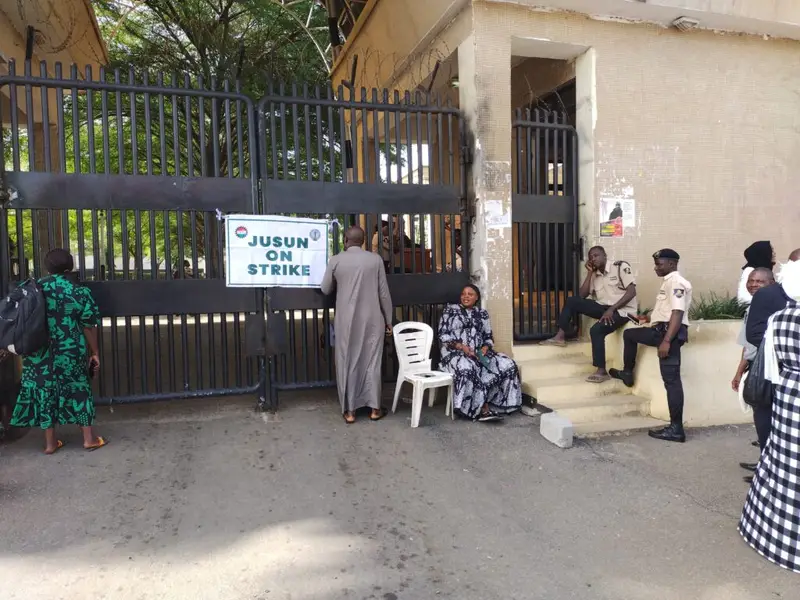
The Judiciary Staff Union of Nigeria, JUSUN, on Monday began an indefinite nationwide strike, effectively shutting down the Federal High Court in Abuja and locking out judges, lawyers, litigants, and court workers.
At the court’s headquarters along Shehu Shagari Way, all entry points were securely locked as union members enforced the strike directive.
This action follows an order from JUSUN’s national leadership instructing all state chapters to stay away from work beginning midnight on Sunday, June 1.
The union said the strike became necessary after failed negotiations with the Federal Government on several outstanding issues.
These include the payment of a five-month wage award, the implementation of the new ₦70,000 national minimum wage, and a 25% to 35% salary increase for judiciary workers.
A circular issued by JUSUN’s acting National Secretary, M.J. Akwashiki, emphasized that the strike will continue “until further notice,” in line with resolutions passed by the union’s National Working Committee and National Executive Council.
READ ALSO: Adeleke constitutes committee to resolve Osun JUSUN strike
“We believe this action is the only way to make our voices heard after unfruitful conciliatory meetings led by the Minister of Labour and Employment,” the statement read.
Despite speculation that some state chapters might withdraw from the strike, by 9:48 a.m. on Monday, the Abuja court complex remained locked with no judicial activities taking place. The disruption has left litigants stranded and court proceedings halted.
Efforts to speak with JUSUN executives at the court premises were unsuccessful, as they were reportedly in a closed-door meeting.
Security officers were seen stationed around the court, ensuring compliance with the industrial action.
This is not the first time JUSUN has resorted to industrial action. In 2021, the union staged a two-month strike to demand financial autonomy for the judiciary—an action that significantly affected the dispensation of justice nationwide.
With this new strike, many fear a fresh wave of delays and backlogs in the nation’s judicial system.
Legal practitioners and court users are now calling on the government to engage urgently with JUSUN to resolve the lingering issues.
NAN