As the US prepares to host the 2026 FIFA World Cup and the 2028 Summer Olympics in Los Angeles, President Donald Trump’s renewed travel ban is raising uncertainty over how accessible these events will be to foreign visitors.
Though Trump has repeatedly expressed enthusiasm for both sporting events, his administration’s latest restrictions have sparked questions about who will be able to attend.
Among the affected nations is Iran, one of Asia’s top soccer teams and the only banned country to have already qualified for the 2026 World Cup. Others like Cuba, Haiti, and Sudan remain in contention.
Fortunately for the teams, athletes, coaches, and essential staff are exempt from the ban under current policy. This ensures that qualifying teams, even from countries under restrictions, can still compete.
The forecast is far less clear for fans. The travel ban does not currently provide any exceptions for spectators from the targeted countries, meaning supporters hoping to cheer on their nations at these events could be barred from entering the US unless policy changes.
Seven years after FIFA announced that the United States, Canada, and Mexico would co-host the 2026 World Cup, President Trump convened the first meeting of his administration’s 2026 World Cup task force.
Questions are already being asked about whether the United States is ready to host the most prestigious sporting tournament in the world, with concerns being raised about visas, infrastructure, and poor security technology, among other issues. So, is America prepared to welcome millions of soccer fans next year, or is it on course to score an embarrassing own goal?
With the World Cup finals a year away, three more teams have joined the tournament in America, bringing the total to ten.
Also Read: Trump bans travel to US from 12 countries
One of Donald Trump’s focus areas since the beginning of his second term in office has been regulating the flow of immigration into the United States.
Recently, Trump announced the ban on nationals from 12 countries from entering the United States. They are Afghanistan, Myanmar, Chad, the Republic of Congo, Equatorial Guinea, Eritrea, Haiti, Iran, Libya, Somalia, Sudan and Yemen
This sweeping proclamation could have wide ramifications regarding football fans’ desire to come to the United States for the World Cup in 2026, even if they are from countries that are not on the restricted list.
U.S. State Department spokesman Tommy Pigott thinks this decision is what the world wanted to see. He told The New York Times, “I believe people coming from all around the world, Americans going to these events, would want to see actions like this. We take security concerns extremely seriously. We want people to be able to go to the World Cup and do so safely.”
Pigott also said that he believes making these decisions are part of what goes into hosting an event of this magnitude.
Sports managers are waiting to see how this situation unfolds, as the United States, Canada and Mexico will host the World Cup in 2026. Trump has made headline news regarding the United States’ portion of this equation in other ways as well.
Task force for World Cup
In early March 2025, Trump signed an executive order creating a White House Task Force for the 2026 World Cup. FIFA president Gianni Infantino was present when the document was signed. But what is the aim of this task force?
The stated mission of the task force is to “showcase the Nation’s pride and hospitality while promoting economic growth and tourism.”
It may come as no surprise that Trump has declared himself the Chair of the Task Force, while also declaring Vice President J.D. Vance the Vice Chair.
Although it would not be surprising for Trump to be heavily involved, the plan is for the Task Force to have an Executive Director. It will be the Executive Director’s job to handle the day-to-day operations of the Task Force.
The Task Force is also going to consist of a number of people in the United States cabinet, such as the Secretary of State, Secretary of the Treasury, Secretary of Defense, the Attorney General, Secretary of Commerce, Secretary of Transportation, Secretary of Homeland Security, and many Trump appointed to these positions when he took office.
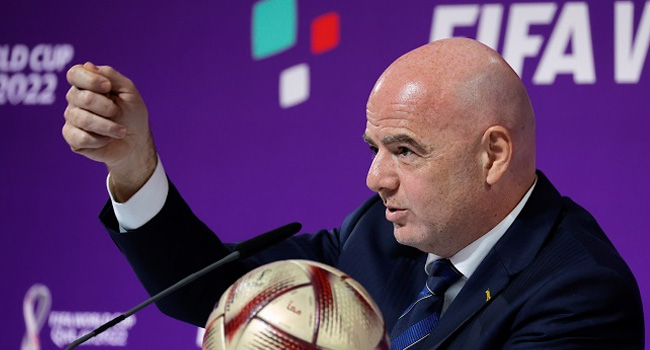
Infantino told The New York Times, “It’s important that everyone who comes to America feels safe and feels welcome and that’s why it’s important that the government brings together this White House task force chaired by the president himself, it shows the importance of the FIFA World Cups.”
Infantino continued, “We have ten million tickets for sale—it’s like three Super Bowls every day for one month.” Trump responded, “I love what he said—three Super Bowls a day for a month. That is what it is. It is amazing when you think about it, I had never heard that expression. That is a lot.”
FIFA yet to react
According to the Guardian, Trump said “First time it’s ever been in this part of the world,” although the United States hosted the World Cup in 1994. Mexico has also hosted the World cup twice, in 1970 and 1986.
Leander Schaerlaeckens of the Guardian wrote, “Just as other mega-events have been hijacked for political ends, this World Cup will be leveraged for the glorification of a leader to a degree not seen since Benito Mussolini dominated the 1934 World Cup in Italy or the Videla regime’s stage crafting of the 1978 World Cup in Argentina.”
Trump himself is fully aware of the United States upcoming schedule. As captured by Yahoo, he said, “We have the Olympics, the World Cup, and number 250 (America’s 250th anniversary). You do not get very much bigger than that.”
Yahoo Sports noted that the tournament is expected to bring around 10 million visitors to North America. Considering Trump’s policies and statements regarding immigration and how Canada and Mexico deal with the topic, that figures to be a situation to watch carefully.