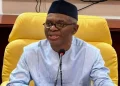
The Plateau State Government has reaffirmed its commitment to the protection and enforcement the rights of children through strengthened legal structures, active prosecutions, and strategic collaborations with civil society and religious institutions.
Mrs. Olivia Dazyem, Chairperson of the Plateau Gender and Equal Opportunities Commission and Special Adviser to Governor Caleb Mutfwang on Gender, said the state was fully engaged in combating child rights abuses.
“Plateau was one of the first states to domesticate the Child Rights Act (2003) into state law as early as 2005. This provided a unique, legal foundation tailored to protect, promote, and defend the rights of children in Plateau,” she stated.
In addition to the Child Rights Law, Dazyem noted that the state had adopted a range of complementary legal frameworks, including the Disability Rights Law (2005), the Gender and Equal Opportunities Law (2015), and the Violence Against Persons Prohibition (VAPP) Law (2022). Collectively, she said, these laws empower the state to address a wide range of violations against children.
To back these laws with enforcement, the state judiciary, under the leadership of the Chief Justice, has designated Family Courts at both the High Court and Magistrate levels, specially mandated to handle child welfare matters. A specialised Gender Court has also been established under the provisions of the VAPP Law to address gender-based crimes.
Dazyem highlighted that enforcement efforts were already producing results. “During my tenure as Commissioner for Women Affairs, parents who abandoned their children were prosecuted under the Penal Code and VAPP Law. Some were sentenced under Section 17 of the VAPP Law, which criminalises such abandonment,” she said.
READ ALSO: First Lady celebrates children, unveils AGILE initiative
She added that since assuming her current role, the commission had secured at least three convictions for parental neglect.
One notable case involved a father who inflicted severe injuries on his child and received a three-month prison sentence. Others involved fathers who sexually assaulted their daughters and were prosecuted accordingly.
Dazyem also called attention to the growing concern over street children, describing their presence as a visible consequence of parental failure, poverty, and insecurity. “When children live on the streets, their right to safety, education, and dignity is violated. It also fuels insecurity,” she warned.
The state’s response has been multi-pronged: prosecuting negligent parents, conducting public awareness campaigns, and partnering with Civil Society Organisations to rescue and shelter vulnerable children.
In cases where family reunification is not feasible, the state works with orphanages and alternative care providers.
A significant part of the intervention, according to Dazyem, is the collaboration with the Jaamatul Nasril Islam (JNI) to address the challenges of the Almajiri system.
JNI has offered shelters and works closely with the government to provide holistic care for affected children.
She concluded by calling on other northern states to emulate Plateau’s proactive approach and urged citizens to support efforts that keep children safe and off the streets. “The wellbeing of our children is inseparable from the security and future of our society,” she said.
NAN