By Josephine Nwachukwu
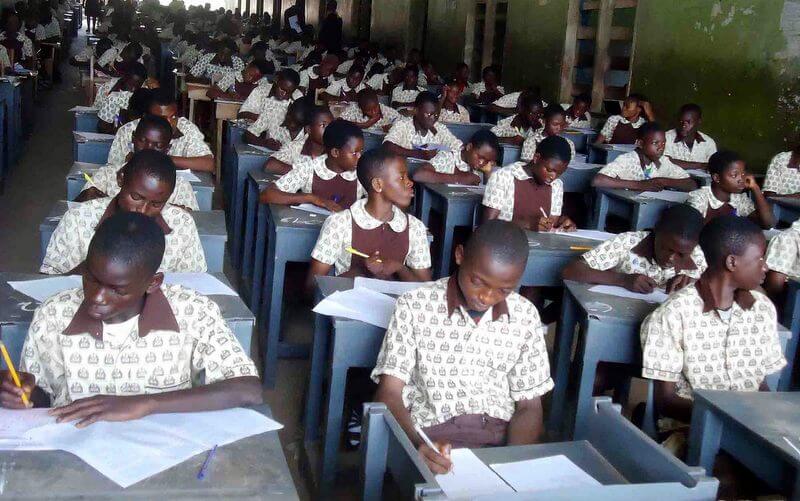
Every day, thousands of Nigerian children walk into schools that should not exist—unregistered, unsafe, and academically unqualified.
These institutions, often disguised as havens of learning, thrive in plain sight, feeding off systemic neglect and public desperation. And for the most part, no one stops them.
In Ebonyi State, however, authorities recently took a decisive step to reclaim the integrity of the education system. In a sweeping enforcement operation, the state sealed 283 illegal and substandard primary and secondary schools.
Professor Paul Nwobasi, the State Commissioner for Education, explained that the affected schools lacked government approval, adequate infrastructure and a standardized curriculum.
“This action is a deliberate strategy to uplift the standard of education in our state. We are determined to safeguard our children’s future from the dangers of poor education,” he stated at a press briefing in Abakaliki.
But Ebonyi is not an outlier. Across Nigeria—from the conflict-ridden zones of Borno, Kano and the southeastern cities of Abia—the unchecked spread of illegal schools reveals a deeper failure in education management.
In Kano State, a northern educational hub with over 7,000 private schools, more than 5,000 are yet to complete the government’s revalidation process. Since 2022, only about 30 schools have been shut down and fined—some as high as ₦10 million—for operating in hazardous conditions.
Comrade Baba Abubakar Umar, Special Adviser to the Private & Voluntary Institutions Board noted that efforts are underway to digitize school data and publish a list of compliant institutions—a small but vital step towards restoring public confidence.
In Borno, where insurgency and displacement have gutted the school system, enforcement is a tall order. Despite a 2022 registration deadline, only 266 schools have complied with regulatory requirements, leaving hundreds more running outside the law.
Commissioner Lawan Abba Wakilbe warned that these institutions are not only illegal but dangerously unfit for learning environments, with legal actions planned against violators.
Abia State, on the other hand, faces an issue that goes beyond legality. Back in the early 2010s, the state shut down over 100 schools for facilitating examination malpractice. Yet the rot remains. Just last year, several schools were blacklisted by WAEC and had their licenses revoked over gross misconduct. “Instead of heeding warnings, they continued to cut corners,” said Commissioner Uche Eme-Uche.
What is most alarming is how visible many of these schools are. Their open operation—and society’s silence—speaks volumes.
In underserved communities, affordability and proximity often take precedence over legality or quality. For many families, especially in rural areas, government schools are either absent or in deplorable condition. In the absence of alternatives, any institution that offers a semblance of learning becomes an option.
Mr. Emmanuel, a teacher with over a decade of experience in south west Nigeria, believes the problem runs deeper than enforcement. “The government has monetised education. Some communities don’t even have one public school. People are simply responding to the need around them.
That is why illegal schools spread—because demand exists,” he said. His words reflect a harsh truth: when public systems collapse, people improvise—even at the cost of quality and safety.
The explosion of unapproved schools mirrors a broader crisis: crumbling infrastructure, economic strain, and lax regulation.
Public schools are often overcrowded, dilapidated, or located miles away from children’s homes. In their place, makeshift schools spring up in church halls, abandoned buildings, wooden buildings with classrooms crudely demarcated by plywood panels, usually with unqualified teachers, no libraries, or labs, and outdated or improvised curricula.
Some of the worst offenders are so-called “miracle centers”—institutions that enable students to cheat on national exams for a fee.
These places do not just fail to educate—they undermine the country’s academic integrity. They are not merely failing children; they are robbing them of their futures.
Another often fronted factor fuelling the proliferation of illegal schools is the poor remuneration of teaching staff, both in public and private sectors. When teachers are underpaid—or not paid at all—they are more likely to leave government schools or formal institutions in search of alternative income, even if it means setting up or working in unapproved, substandard schools. Some settle for these illegal setups simply because they offer quicker, albeit unstable, pay.
READ ALSO: Ebonyi shuts 283 illegal schools statewide
In many cases, school proprietors also cut corners by hiring unqualified teachers at lower wages to reduce costs. The result is a cycle of exploitation and mediocrity where poorly motivated staff deliver poor-quality education, further deepening the crisis. Until teaching is treated as a dignified and well-compensated profession, efforts to sanitize the education system will continue to fall short.
Responsibility for oversight lies with State Ministries of Education, Private School Regulatory Boards, and Quality Assurance Departments. Yet these bodies often lack adequate funding, staffing, and sometimes integrity. Bribery and nepotism allow many substandard schools to operate despite repeated violations.
The lack of a central, accessible database of approved schools makes it impossible for parents to verify legitimacy—creating fertile ground for fraud and exploitation.
As Mr. Emmanuel puts it, “You can’t stop self-medication when there is no access to free hospitals.
Until functional public schools are available to all, illegal schools will remain a default option.” His analogy captures the gravity of the situation: this is not just a regulatory lapse—it is a structural crisis.
Registration is another major hurdle. For proprietors of low-cost schools, the process is often a bureaucratic maze. Requirements typically include land ownership documents, approved building plans, certified teachers, science labs, libraries, sick bays, fire and environmental safety certificates, and Corporate Affairs Commission registration—plus multiple levies.
Many grassroots educators cannot afford these costs or the 6–12 months it often takes for approval. Out of desperation or necessity, they start teaching immediately – unregistered, unregulated, and often unqualified.
Experts and civil society organizations argue that sealing schools alone will not solve the crisis. What is needed is a thorough, multi-layered approach that addresses both the demand and supply sides.
First, states must publish and regularly update online lists of approved schools—publicly accessible and easy to verify. Second, parents must be educated on how to spot and report illegal institutions.
Third, governments must streamline the school registration process, introducing provisional licenses for schools that meet basic standards but lack capital for full compliance.
Finally, there must be serious investment in public education—especially in rural and underserved areas—to eliminate the vacuum these illegal schools fill.
NGOs also have a key role to play—by conducting community awareness programs, offering digital tools for school verification, and advocating for inclusive and practical education policies. Their involvement can bridge the gap between policy and lived reality, especially in hard-to-reach communities.
Nigeria stands at a crossroads. Either it addresses this crisis with urgency, transparency, and compassion—or it risks raising generations who went to school but never truly acquired knowledge.
The crackdown in Ebonyi is a commendable beginning, but the fight must go national. Enforcement must evolve into a campaign for educational justice.
A school uniform is not an education. And until the system makes that distinction clear, the cycle will continue—and the cost will be far greater than poor grades.
Crediblenewsng.com