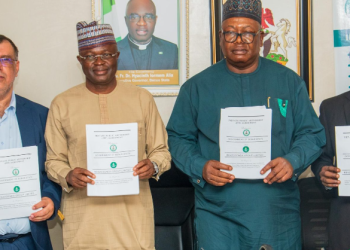
The Federal Government has officially launched the Accelerated Basic Education programme aimed at addressing Nigeria’s long-standing challenge of mass illiteracy.
The programme is designed to bring basic literacy and education to approximately 80 million Nigerians — mainly underserved youth and adults — who currently fall outside the formal education system.
The ABE initiative was unveiled on Wednesday during a one-day National Stakeholders Engagement Meeting on Youth and Adult Literacy, held in Abuja.
Representing the Minister of State for Education, Prof. Suwaiba Ahmad, was her Special Assistant (Technical), Dr. Claris Ujam, who provided key insights into the programme’s structure and objectives.
Prof. Ahmad said the ABE would focus on reaching non-literate Nigerians “wherever they are,” with flexible and community-based literacy models that maintain both quality and relevance.
The initiative is expected to be implemented across Nigeria’s six geopolitical zones, using strategies that reject barriers like age, location, and socio-economic status.
Citing data from the 2022 report by the National Bureau of Statistics, Ahmad noted that nearly 80 million Nigerians — representing 31 per cent of the country’s estimated 250 million population — lack basic literacy skills. She described this as a “silent crisis” that limits both individual growth and national development.
“Our mission is unequivocal — to craft pathways of hope, dignity, and opportunity through the instrumentality of accelerated basic education,” Ahmad stated. “The ABE programme is not just a response to a problem; it is a movement built on inclusion, adaptability, and innovation.”
ALSO READ: Gov. Mbah pushes education reform with global expertise
According to her, the programme aims to re-engage out-of-school children, early school-leavers, and adults through mobile, digital, and community-driven learning channels.
Dr. John Edeh, Director of Literacy and Development at the National Commission for Mass Literacy, Adult and Non-Formal Education, highlighted the urgent need for such a programme.
He said many young Nigerians have been excluded from education due to poverty, conflict, and other socio-economic factors.
“NMEC serves as the gateway for millions of Nigerians to re-enter the learning process. These young people deserve a second chance,” Edeh said.
He emphasised the importance of partnerships with state agencies, civil society organisations, and development partners. “Our focus is to provide learner-centered solutions by meeting people where they are — physically, emotionally, and socially,” he added.
Edeh outlined several strategies that the commission will adopt to ensure the programme’s success. These include enhanced data collection, improved monitoring, youth-friendly curricula, and the integration of digital learning tools. Funding and resource mobilisation were also identified as critical areas of focus.
Both speakers called on NGOs, community leaders, donors, and education advocates to collaborate in the rollout of the ABE programme, ensuring it reaches the most marginalised and underserved populations.
The launch of the ABE programme is seen as a strategic intervention in Nigeria’s education sector, which has long struggled with the challenge of adult illiteracy and out-of-school children.
If implemented effectively, the initiative could significantly reduce Nigeria’s literacy gap and provide new opportunities for millions.