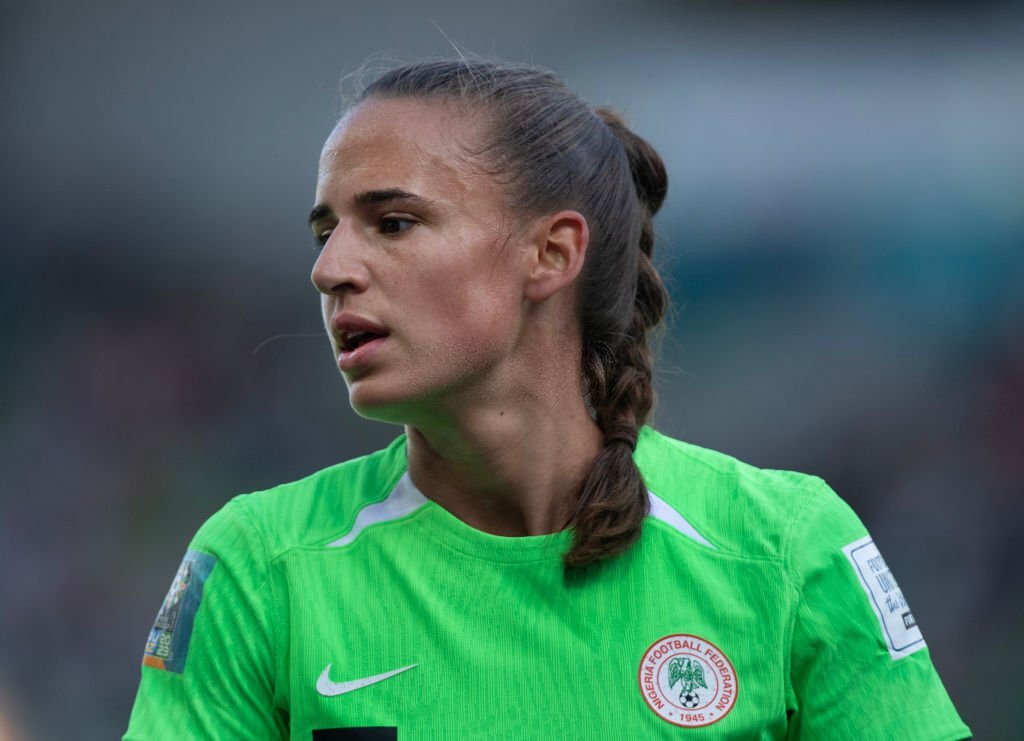
Ashleigh Plumptre’s career took an unexpected turn in 2023 when she left Leicester City for Saudi Arabia, a move that made her the first player to swap England’s Women’s Super League for the Saudi Women’s Premier League, SWPL.
Two years later, the Nigeria international has signed a contract extension with Jeddah-based Al-Ittihad, embracing life in the Middle East while navigating the controversy her move sparked.
At the time of her switch, Plumptre was 25 and approaching the end of her contract with Leicester, the club she had supported since childhood.
She wanted a new project that would inspire her and allow her to grow as both a person and a footballer. Saudi Arabia was not her first thought.
“When my dad, who is also my agent, mentioned a team in Saudi Arabia, my reaction was, ‘no way’,” she admitted. “But I wanted to give them a chance.” After an hour-long video call with Al-Ittihad’s coach and staff — where the discussion was more about personal values than football — Plumptre visited Jeddah. Two days later, she knew it was where she wanted to be.
The move made headlines worldwide. Saudi Arabia’s investment in women’s sport has been rapid since the SWPL was launched in 2022, mirroring the high-profile arrivals of global stars such as Cristiano Ronaldo and Neymar in the men’s Pro League.
Clubs in the women’s competition are permitted six foreign players, and salaries are competitive — ranging from $60,000 to $120,000 per year, tax-free.
Still, Plumptre insists money was not her motivation. “It was the project, the feeling I had with the people here,” she said. “It wasn’t about football first, it was about who I am as a person.”
Plumptre’s choice was celebrated in some circles but criticised in others, particularly within women’s football, where LGBT supporters are visible and vocal. Same-sex relations remain illegal in Saudi Arabia, and her move prompted backlash from fans who once saw her as an ally.
“At Leicester, we had close ties with the LGBT supporters’ group,” she recalled. “When I came here, some felt betrayed, like I was no longer the person they thought I was. That hurt. I understand why they felt that way, but it doesn’t mean I condone things just because I live here.”
Plumptre describes life in Saudi Arabia as unexpectedly calm and safe. Like many expatriates, she lives in a residential compound — gated communities with gyms, pools, restaurants, and other amenities.
She recalls once leaving her car running with the keys inside while unloading shopping, something she says she could never imagine doing in the UK.
READ ALSO: Super Eagles names 23-man squad for World Cup qualifiers
“A friend who visited called it a peace bubble,” she said. “Here I don’t feel the same anxieties I sometimes felt back home. Of course, every woman has some level of fear walking at night anywhere, but the way men behave here means that fear is lower.”
Saudi Arabia has made reforms in recent years, lifting bans on women driving and travelling without a male guardian.
But rights groups argue that restrictions remain, and many cultural practices still place limits on women. Plumptre acknowledges this, but insists her personal experience has been positive.
On the pitch, the SWPL is still growing. While players such as Plumptre, Nigeria star Asisat Oshoala (Al-Hilal), and France internationals Amel Majri and Kheira Hamraoui have raised its profile, the league struggles with small crowds and a wide skill gap between local and international players.
“We don’t have many fans,” Plumptre admitted. “There aren’t yet the same community programmes to bring families and children to matches like in England. That’s something clubs here need to develop.”
Al-Ittihad, she says, have provided strong support, giving the women’s squad access to medical clinics, locker rooms, and training facilities — though often older ones passed down from the men.
Evening training sessions are scheduled to avoid the intense heat, something Plumptre enjoys because it reminds her of her academy days at Leicester.
“The facilities are good, but of course the men have the very best. It’s about pushing for progress step by step, and people do listen when we raise issues,” she explained.
Saudi Arabia is preparing to host the men’s World Cup in 2034, and speculation has grown about a future Women’s World Cup bid. But Plumptre believes that would be premature.
“In the near future I’d say no,” she said. “Everything takes time. I want to help these Saudi players develop at their own pace. If you put them on the world stage before they’re ready, it’s unfair to them and to the sport.”
For Plumptre, the focus remains on making a difference within her club and league. Her decision to stay at Al-Ittihad shows her commitment to shaping the future of women’s football in Saudi Arabia — even if her journey continues to divide opinion.
BBC Sport