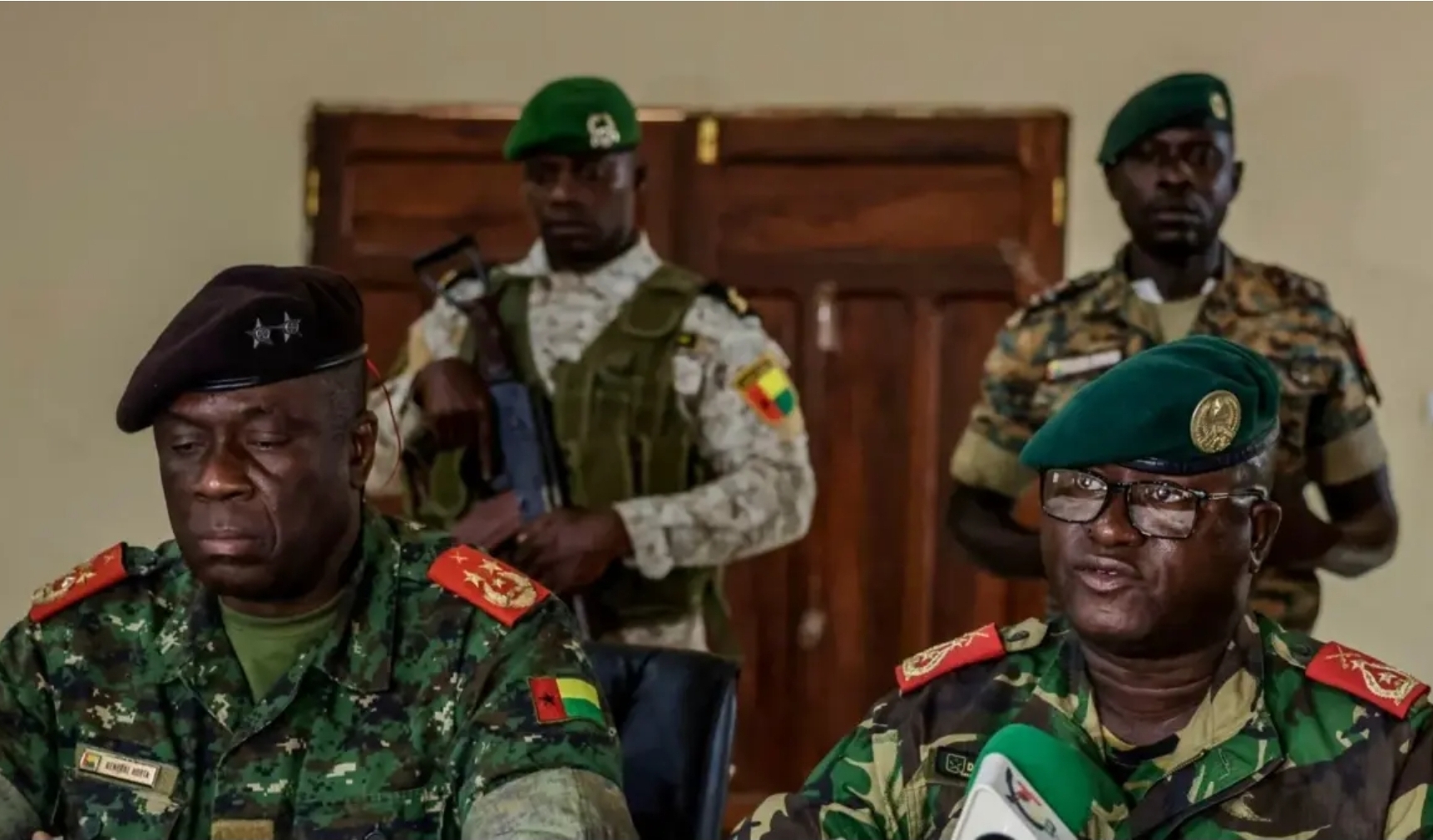
A group of army officers said on Wednesday they had seized power in Guinea-Bissau, Radio France Internationale reported, after gunfire was heard at key locations in the capital.
The army officers said they had formed “The High Military Command for the Restoration of Order” and would be in charge of the West African nation until further notice.
The move came one day before the electoral commission was due to announce provisional results from a hotly contested presidential election between incumbent President Umaro Sissoco Embalo and top challenger Fernando Dias.
Both sides have claimed victory in Sunday’s first round ballot.
Also Read:Guinea-Bissau dissolves parliament after coup attempt
The gunfire on Wednesday was heard near the electoral commission headquarters, presidential palace and interior ministry, witnesses said. It lasted for about an hour but appeared to have stopped by 1400 GMT, a Reuters journalist said.
Long history of Political Turmoil
Guinea-Bissau’s military officers announced they are assuming “total control” of the country, suspending the electoral process and closing borders three days after a fiercely contested election in which both incumbent Umaro Sissoco Embaló and challenger Fernando Dias claimed first‑round victory. In a televised statement from army headquarters, a spokesperson said a “High Military Command for the Restoration of Order” would govern until further notice. Embaló later told international media: “I have been deposed.”
Gunfire was heard near the electoral commission, the presidential palace and the interior ministry on Wednesday before the military’s announcement. Officers said borders were shut and a curfew would be enforced as the electoral process was halted. Each camp accused the other of orchestrating the unrest; neither provided evidence. The election commission had been due to release provisional results on Thursday. It remained unclear whether the officers commanded the full support of Guinea‑Bissau’s fractious armed forces or controlled the entire territory of the nation of roughly 2.2 million people.
From Transition to Turmoil
The country’s latest rupture follows a decade marked by recurrent institutional crisis. After a 2012 coup, a transitional administration gave way to a democratically elected government in 2014 under President José Mário Vaz. Yet the 2014–2020 term was marred by relentless power struggles with successive prime ministers, cabinet reshuffles and a parliament often unable to function. Local communities and international missions increasingly stepped in to resolve disputes amid questions over judicial independence and the absence of elected bodies at local and regional levels—fragilities that left the political system exposed.
The Disputed 2019 Election and Court Ruling
In the December 2019 presidential runoff, Umaro Sissoco Embaló defeated Domingos Simões Pereira of the PAIGC. The opposition challenged the legality of Embaló’s inauguration, triggering months of legal wrangling and a tense standoff in Bissau. In September 2020, the Supreme Court dismissed the petition and upheld the results. The PAIGC ultimately accepted the ruling, but the episode deepened mistrust between political factions and set the tone for a presidency defined by confrontation with parliament and rivals.
February 2022: A Foiled Coup with Fatal Clashes
On February 1, 2022, heavy gunfire erupted around the government palace during what authorities described as an attempt to overthrow President Embaló. At least six people were killed as loyalist forces repelled the attack. The government blamed dissident elements and criminal networks; critics questioned competing narratives. The episode underscored the enduring volatility of the security sector and the risks posed by entrenched interests in a state long vulnerable to narco‑trafficking and political interference.
Crediblenewsng.com