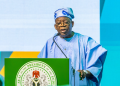
President Bola Tinubu has announced that Nigeria will end the practice of running multiple budgets by March 2026, declaring that the country will operate a single budget supported by one revenue cycle from April next year.
The president made this known on Friday while presenting the 2026 Appropriation Bill of N58.18 trillion to a joint session of the National Assembly in Abuja.
The budget, themed “Budget of Consolidation, Renewed Resilience and Shared Prosperity,” is aimed at strengthening ongoing economic reforms and stabilising public finance management.
Tinubu acknowledged that the nation has grappled for years with overlapping budgets, abandoned projects and unpaid contractual obligations inherited from previous administrations and unfulfilled mandates.
He described the situation as a major challenge that has constrained effective budget execution and fiscal discipline.
He stated that the government was taking decisive steps to put an end to the practice, stressing that all outstanding capital liabilities from previous years would be fully funded and closed by March 2026.
“By April, Nigeria operates on a single budget, backed by a single revenue cycle. No overlaps, no excuses and no rollover cultures,” the president said.
Tinubu described the 2026 budget as a defining moment in Nigeria’s reform journey, noting that his administration has spent the past two and a half years confronting deep-rooted structural weaknesses in the economy.
He said the reforms were designed to stabilise the economy, rebuild communities and lay a solid foundation for a more resilient, inclusive and dynamic nation.
Also Read: Tinubu admits failure of budget proposals, seeks repeal
While admitting that the reform process has been difficult, Tinubu said the sacrifices made by Nigerians were beginning to yield results.
“Families and businesses have faced pressure. Established systems have been disrupted and tested. Budget execution has also been tested. I acknowledge these difficulties plainly,” he said.
The president assured Nigerians that the country had moved past the period of uncertainty and economic volatility, insisting that the economy had “turned the corner.”
He said the 2026 budget seeks to consolidate recent gains, deepen economic resilience and move the nation from survival to growth.
He added that the plan prioritises macroeconomic stability, competitiveness and inclusive growth that delivers decent jobs, rising incomes and improved quality of life.
Tinubu noted that early signs of recovery were already evident, citing economic growth of 3.98 per cent in the third quarter of 2025, an improvement from 3.86 per cent recorded in the same period of 2024.
In his welcome address, Senate President Godswill Akpabio said collaboration between the National Assembly and the Executive was often misunderstood by some Nigerians as a weakness of the legislature.
He argued that history has shown that nations make progress when both arms of government work together, warning that hostility between them often leads to stagnation.
Akpabio described the 2026 Appropriation Bill as more than a financial document, saying it represents a clear statement of national priorities, difficult policy choices and a roadmap for the next phase of Nigeria’s renewal.
NAN