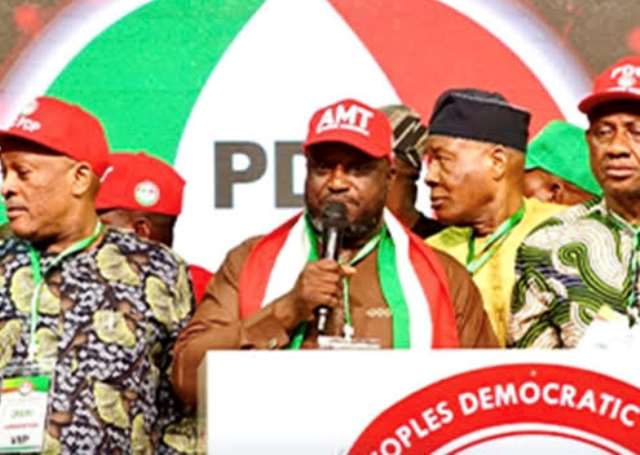
The founding fathers of the People’s Democratic Party, PDP, must feel quite uncomfortable with the musical chairs around Africa’s fabled largest political party.
Many will also remember with nostalgia the ambition of its leaders in the advent of the Fourth Republic. The PDP was destined to rule for 60 years without break, they chorused!
The Supreme Court’s nullification of the November 2025 convention has done more than cancel one faction’s claim to legitimacy; it has exposed how fragile the party’s internal structure has become. While the immediate dispute was over who controls the National Working Committee, the deeper issue is whether the party can still act like a coherent national opposition after months of legal warfare, suspensions, rival conventions and competing power centres. The governors-backed camp now says the judgment leaves the party without a valid NWC, while the Board of Trustees has stepped in to prevent a vacuum and steer the party toward an emergency reset.
At the centre of the crisis is a legal verdict with major political consequences. The Supreme Court, in split 3–2 decisions, voided the Ibadan convention that produced the Tanimu Turaki-led leadership, holding that the exercise breached subsisting court orders. The Federal High Court earlier found defects around compliance with statutory requirements, including notice to INEC and the conduct of valid congresses in enough states before the convention. In practical terms, the ruling stripped the Tanimu faction of legal cover, but it did not automatically create political consensus around the Wike camp.
That is why the argument advanced by Babangida Aliyu is politically significant. His position is that the judgment not only nullified the November 2025 convention but also, by implication, undermined the March 2026 arrangement associated with the rival bloc because key actors involved in that process remained under suspension. On that reading, neither camp can honestly claim a clean mandate, leaving the party structurally exposed and forcing the BoT to present itself as the only surviving stabilising organ. Whether every faction accepts that interpretation is another matter, but it explains why the battle has now shifted from the courtroom to the party’s constitutional organs.
The Board of Trustees’ takeover is therefore less a victory lap than an emergency intervention. Adolphus Wabara said the BoT moved in to avoid a leadership vacuum and to create room for reconciliation and the possible appointment of an interim leadership structure. Reports indicate that the BoT sees itself as a constitutional bridge, not necessarily the final destination. That distinction matters. If the BoT becomes a neutral umpire capable of convening a credible NEC process, it could help lower tensions. But if it is seen as merely another factional instrument, the crisis will deepen.
Also Read: Supreme court nullifies PDP Ibadan convention
The party’s future now depends less on legal interpretation and more on political management. The immediate tests are straightforward: can the BoT and NEC produce an arrangement accepted across the major blocs; can they halt further defections; and can they persuade aggrieved heavyweights that there is still a viable platform worth returning to?
Aliyu’s repeated emphasis on reconciliation shows that key stakeholders understand the danger. A party preparing seriously for a general election should be building coalitions, recruiting candidates and sharpening its message. Instead, it is still arguing over who has the authority to sign letters, convene meetings and speak for the organisation. That is the larger political tragedy.
The opposition’s crisis is no longer just an internal party matter; it has implications for Nigeria’s democratic balance. Aliyu explicitly framed the moment as a threat to multi-party democracy, arguing that the country cannot afford to drift toward a de facto one-party system. This may sound like partisan rhetoric, but it reflects a real concern: when the largest opposition platform is consumed by procedural warfare and elite rivalry, the ruling party benefits by default. The weakness of the opposition reduces electoral competition long before voters cast ballots.
The role of Nyesom Wike remains one of the biggest variables in this story. A few analysts think that the Supreme Court judgment effectively ended the legal challenge to the faction aligned with the FCT minister, and that bloc initially claimed victory. Yet the governors camp insists the ruling leaves no clear leadership standing at all. This contradiction captures the central problem: the party has too many powerful actors and too little shared legitimacy. Unless the next round of decisions produces a mutually tolerable formula, every “victory” will remain provisional and every reconciliation effort vulnerable to collapse.
There is also a harsh electoral reality. The party’s crisis has intensified since the 2023 elections and that waves of defections have already weakened its state and legislative strength. A party can survive courtroom defeats more easily than it can survive a collapse of elite confidence. Once governors, lawmakers, financiers and aspirants begin to doubt that a platform can organise primaries fairly or defend mandates effectively, they start shopping for alternatives. That is how legal crises turn into existential crises.
Still, the ruling may offer one final opportunity. By knocking out contested claims and forcing the party back to its constitutional organs, the Supreme Court may have created the shock necessary for a genuine reset. If the BoT uses the Sunday and Monday meetings to establish a broadly acceptable interim structure, launch a credible reconciliation process and set a lawful path to a fresh convention, the party can still recover enough coherence to remain relevant in 2027. But if those meetings become another arena for factional triumphalism, then the judgment will be remembered not as the beginning of renewal, but as the moment the party’s long decline became impossible to deny.
In the end, the future of the party will not be decided by who celebrates Thursday’s judgment more loudly. It will be decided by whether its leaders can do three things quickly: restore a legitimate chain of command, reconcile rival camps and convince Nigerians that the opposition can once again behave like a government-in-waiting.
Without that, the talk of survival and 2027 readiness will remain aspirational.
Crediblenewsng.com