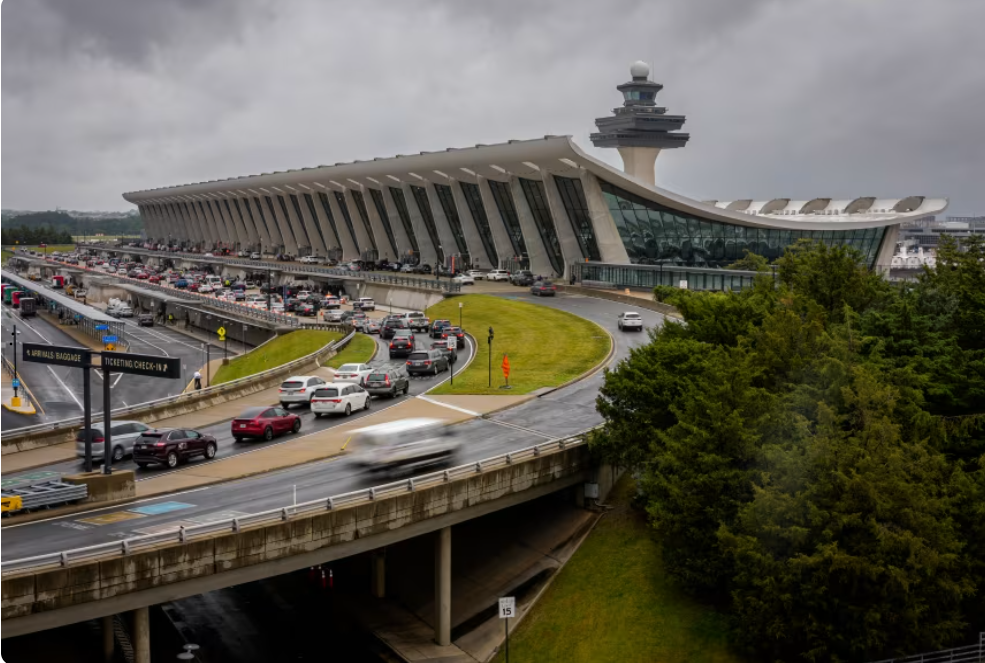
Hours before, US District Judge Leonie Brinkema stated in her order that “the welfare of the petitioners and the interests of justice are best served by allowing petitioners to return home immediately.”
Earlier, Brinkema told the US government Friday that the pregnant woman, who came to the United States from Ghana for a medical appointment for her child but also acknowledged to authorities she planned to seek asylum, must be released from the hold room at the airport before the end of the day.
“She cannot spend tonight at Dulles,” said Brinkema, a Clinton nominee to the federal bench, at a hearing in Alexandria, Virginia. “One way or another, we’re going to get her out.”
After an immigration judge denied her asylum request on Wednesday, making it virtually impossible for Gyasi and her son to remain in the country, her legal team said its main concern was her well-being after what turned into an indefinite layover.
“We were very pleased that the judge recognized one fundamental principle, which is that human beings should not be detained under the conditions our client was being detained at Dulles Airport in a windowless room without access to appropriate food or medical care,” said Mary Bauer, executive director of the ACLU of Virginia.
Gyasi’s case is among the latest to be challenged in a federal court system struggling to keep up with the administration’s aggressive moves to maximize the number of immigrants removed from the US and increase vetting of visitors on non-immigrant visas.
Gyasi, 38, came to the United States on a tourist visa after getting an appointment for her son at the Akron Children’s Hospital to be evaluated for possible surgery to address severe physical abnormalities affecting his fingers on both hands, the petition states. They’d travelled to the US for treatment two years earlier, but Gyasi was told her child was too young for surgery at the time. Their tourist visas expire in 2028, the petition states.
Instead of being able to board her connecting flight to Ohio, the Ghanaian citizen – who is four and a half months pregnant – and her son were “locked in a holding room” at the airport and “denied adequate food and medical care,” her petition said.
Also Read: Judge orders removal of Trumps name from Kennedy Centre
They were taken into custody after Gyasi “disclosed her fear of returning to Ghana based on the persecution she and her son faced,” when being questioned at US Customs, according to the allegations in the document.
Gyasi, who is a teacher, told authorities her mother “is a traditional priest and when she saw my child as a baby and his disability, she said I should kill him,” according to a government transcript of her statement to an immigration officer.
Gyasi “claimed a fear of returning to Ghana, received a credible fear interview from an asylum officer, and review of that negative credible fear determination by an Immigration Judge, who affirmed the asylum officer’s determination. And thus, her expedited removal order stands ready to be executed through her removal to Ghana,” the government wrote in the court filing.
The mother was hospitalized twice over the past week, initially for light-headedness and then for vaginal bleeding, the petition said, which doctors said was due to high stress and high blood pressure. The medical staff was also “concerned that she was not eating enough and fed her. They even gave her food to take back with her,” her attorneys allege in the court document.
She told officials she and her son are not familiar with the food in the US, and it is making her sick and weak, according to a transcript in the court documents.
Four days after her arrival – and after repeated requests for more food – the petition said Gyasi agreed to be deported, “fearing that she might lose her unborn child.”
“Because I’m pregnant, I am getting weaker and weaker by the day,” she told a CBP officer, according to the official transcript.
Her son had “spent much of the day crying because of his hunger pains,” and CBP officers allegedly denied her request to purchase food, “saying she could only access the food they gave her,” the petition said.
But after she initially agreed to drop her asylum request, officers “offered to get her whatever food she wanted” and let her and her son shower for the first time since their detention,” according to her petition.
Gyasi’s attorneys said her agreement for self-deportation was prompted by “desperation for the health and well-being” of her son and her unborn child and that she did “not wish to relinquish their asylum claims.”
“These windowless rooms were never designed for long-term detention,” said Eden Heilman, Gyasi’s lead attorney with ACLU of Virginia.
The Department of Homeland Security said the allegations of mistreatment “are false.” “Everyone in CBP custody, including this individual, has access to appropriate care, including medical evaluation by a doctor, medication, and food,” a DHS spokesperson told CNN Thursday. “The individual is currently in CBP custody at Washington Dulles International Airport and will remain in custody pending her immigration hearing.”
Gyasi said in a statement to immigration authorities under oath she had been researching the possibility of claiming asylum “for the past 2 years” after officers examined her phone and found a history of searches on the topic, a CBP officer wrote, adding she had also considered asylum in Canada and Australia.
Her attorneys argue she is being punished for her honesty. “If she did not disclose the fear that she was having about persecution in her country, she could have still entered on the tourist visas,” Heilman told CNN. “Unfortunately, because she was honest and shared her concerns, that’s what funnelled her into this separate asylum-seeker category.”