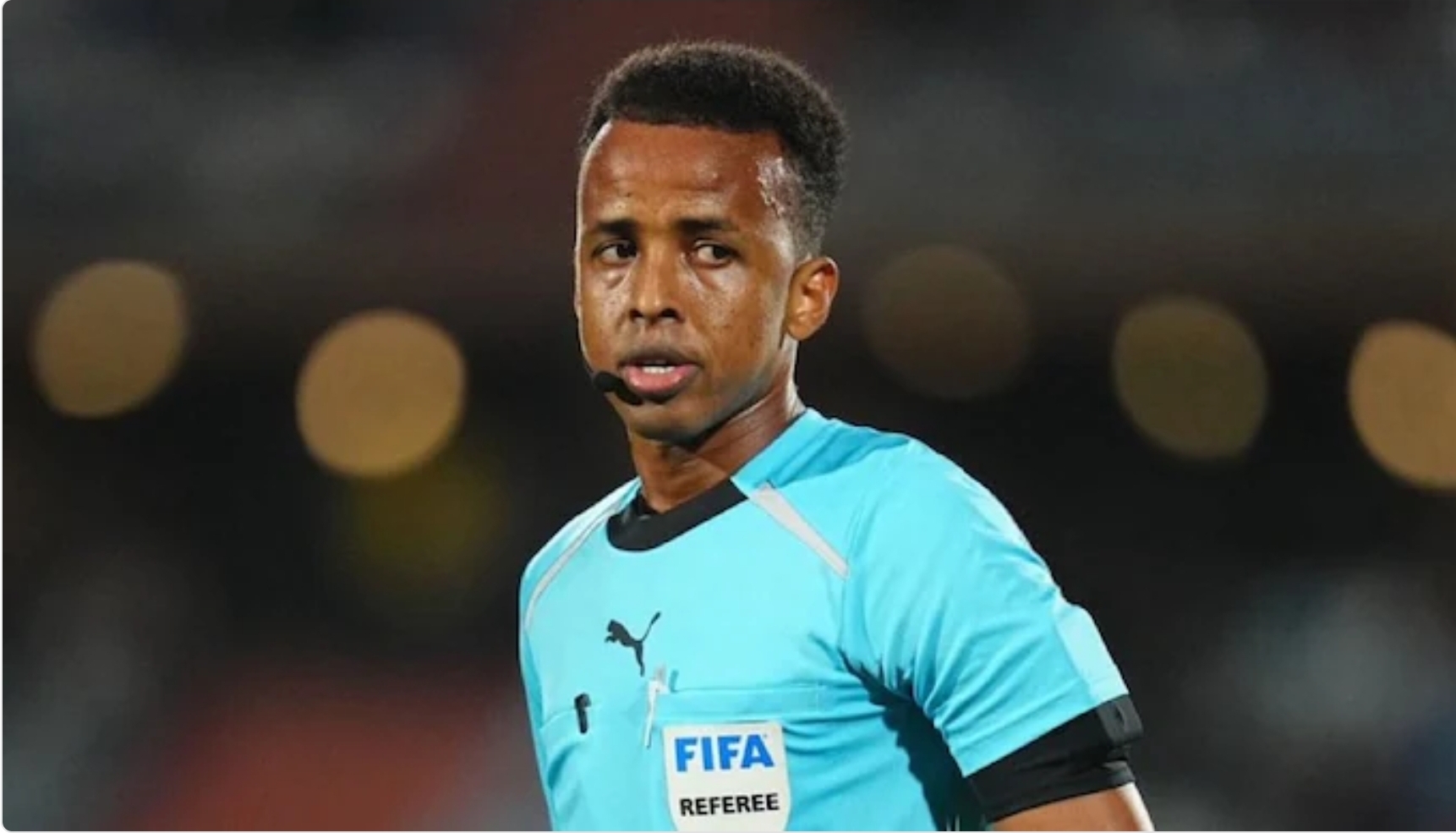
Omar Artan’s World Cup role has been thrown into doubt after the Somali official was reportedly refused entry despite being selected by FIFA.
The 2026 Men’s World Cup has not even kicked off, yet the tournament’s organization in the United States is already facing an embarrassing travel controversy after the Somali was reportedly refused entry and sent away.
Artan, one of Africa’s most respected officials, had been selected by FIFA to work at the tournament and was set to make history as the first Somali referee involved at a senior World Cup.
Instead, his preparation has been disrupted by an immigration episode that raises fresh questions about how carefully this expanded tournament has been planned.
According to the Daily Mail, Artan arrived in Miami but was denied entry by United States officials and deported. He is now reportedly back in Istanbul while the situation is being assessed.
Also Read: FIFA outlaws reusable water bottles at World Cup
The incident is particularly awkward because Artan was not a late addition or an obscure figure arriving without football credentials. He was named Africa’s best referee in 2025 by the Confederation of African Football and has handled major continental matches, including in the CAF Champions League.
Why Omar Artan’s deportation is so damaging
For FIFA, this is a terrible look at a time when the governing body is trying to present the 2026 Men’s World Cup as the biggest and most polished edition in history.
Artan was one of eight CAF referees appointed for the tournament, which will feature 104 matches across the United States, Mexico, and Canada. Referees are expected to attend preparation work before taking charge of matches, making travel access an essential part of the operation.
If an appointed official can arrive for the tournament and still be turned away, it points to a level of administrative uncertainty that should worry teams, players, officials, and supporters.
It also places another spotlight on the United States as a host nation under Donald Trump, where immigration policy and major global sporting logistics were always likely to collide.
World Cup travel issues keep piling up even as Artan’s case is not happening in isolation.
Reports have already raised concerns around other World Cup travel complications, including issues affecting Iran’s delegation and other participants trying to navigate United States entry rules.
FIFA has sold this World Cup as a global celebration, but global tournaments depend on global access. When selected officials are caught in border confusion days before kick off, it becomes harder to pretend the problem is only paperwork.
Artan’s case may still be resolved, but the damage is already obvious.
A World Cup built on size, spectacle, and commercial ambition is now being reminded that organization matters just as much as branding.