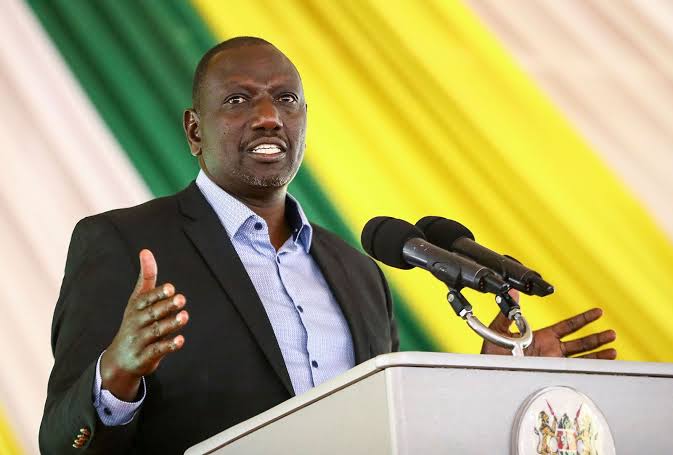
Public anger is mounting in Kenya as President William Ruto forms closer ties with U.S. President Donald Trump’s administration.
The main target of Kenyans’ ire in recent weeks has been the construction of a U.S. Ebola quarantine facility in the town of Nanyuki, with Ruto’s critics accusing him of capitulating to U.S. interests over those of Kenyan citizens.
This month, protesters clashed with Kenyan police as they demonstrated against the U.S. government-funded facility, intended to house Americans suspected of exposure to Ebola in neighboring Democratic Republic of Congo, where the current outbreak is concentrated; South Sudan; or Uganda. Three people were killed, including at least one who was shot dead by the police.
Kenya has never recorded an Ebola case in its territory. The Kenya Medical Practitioners, Pharmacists, and Dentists Union denounced the arrangement as a way to turn the country into a “dumping ground” for the United States while Kenya’s own healthcare system struggles with chronic underfunding.
n the face of criticism, Ruto has defended the decision to build the facility, maintaining that “we are doing the right thing.”
On May 29, Kenya’s High Court temporarily paused plans to open the facility following a lawsuit filed by the Law Society of Kenya and Katiba Institute, a civil society group. Yet while the government claims it has suspended the project, satellite imagery has shown that construction of the 50-bed center has continued.
Also Read: Kenya arrests protesters of Ebola quarantine centre
The Katiba Institute recently filed a contempt of court application ahead of a June 18 hearing and argued that continued construction suggests “that both the Kenyan and the United States governments view themselves as entirely above the Kenyan judicial system.”
“The Trump administration is encouraging the breakdown of respect for the rule of law not just domestically but in other countries as well. Expecting Kenyan President William Ruto to ignore his own system’s court order is enabling authoritarian practices,” said Kate Hixon, the Africa advocacy director at Amnesty International USA.
While the fallout from the arrangement is unlikely to unseat Ruto, it builds on existing public anger over the president’s overall approach to Trump as well as Kenya’s cost-of-living crisis, and it has helped unite the opposition and civil society groups against him.
Public frustration has risen sharply since Kenya became the first African country to sign a bilateral health aid agreement with the United States last December. Kenya’s High Court halted the implementation of the $1.6 billion deal later that month, following a lawsuit over data privacy concerns and a lack of public and parliamentary consultation, but it has since lifted the pause.
Anger with the Ruto administration has been compounded by Kenya’s newly introduced 2026 Finance Bill, which seeks to reinstate several contentious tax measures that were the focus of Gen Z-led anti-government protests in 2024. At the time, Ruto decided not to implement the tax hikes due to discontent.
Now, opposition figures are calling for Kenyans to turn out in large numbers on June 25 to mark the two-year anniversary of those protests, during which at least 63 people were killed. Beyond the planned demonstrations, further nationwide marches are likely, as Kenyans become increasingly fed up with an administration that refuses to listen to them.
Nosmot Gbadamosi