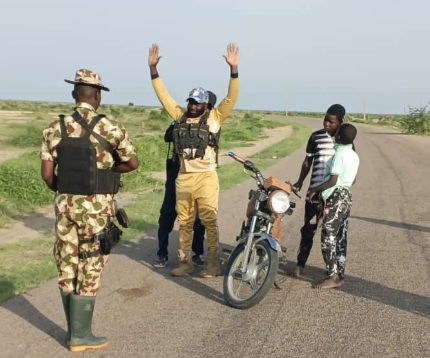
The Nigerian military says a senior finance operative of the Islamic State West Africa Province, ISWAP, has surrendered to troops of Operation Hadin Kai in Borno State.
The military said the suspect, identified as 40-year-old Musa Usman, surrendered alongside his two sons on July 25 along the Ladari–Jegarawaji–Tunokalia corridor on the Gamboru–Wulgo main supply route. It described the surrender as part of a growing wave of disarmament following sustained military operations across the North-East.
Acting Military Information Officer of the Headquarters Joint Task Force North-East, Operation Hadin Kai, Lt.-Col. Mohammed Goni, said Usman surrendered with his sons, 10-year-old Abubakar Musa and 15-year-old Awwali Musa.
He said Usman was among 46 alleged terrorists and their family members who voluntarily surrendered amid sustained land and air offensives targeting insurgent strongholds in the region.
The military said items recovered from the suspect included one AK-47 rifle, four AK-47 magazines, 101 rounds of 7.62mm special ammunition, one motorcycle and ₦40,000 in cash.
Also Read: Troops kill ISWAP cameraman, uncover foreign operatives
During preliminary interrogation, the military alleged that Usman served as the chief finance officer of the ISWAP enclave at Jubillaram, where he managed the group’s finances, logistics and resource distribution.
It said Usman and his children are undergoing profiling and interrogation to obtain intelligence that could support ongoing operations against remaining ISWAP fighters and their support networks.
The military said the latest surrender reflected the impact of sustained pressure on insurgent groups operating in the North-East and urged members of the public to continue providing credible intelligence to security agencies.
In May 2026, the military announced the killing of Abu-Bilal al-Minuki during a joint operation with the United States after U.S. President Donald Trump publicly announced the operation.
The announcement drew scrutiny because the Defence Headquarters had reported in April 2024 that a commander using the same alias had already been killed.
Military authorities later clarified that the two reports referred to different individuals, explaining that Boko Haram and ISWAP commanders frequently adopt identical aliases to complicate intelligence gathering. The Presidency also described the earlier report as a case of mistaken identity.
ICIR