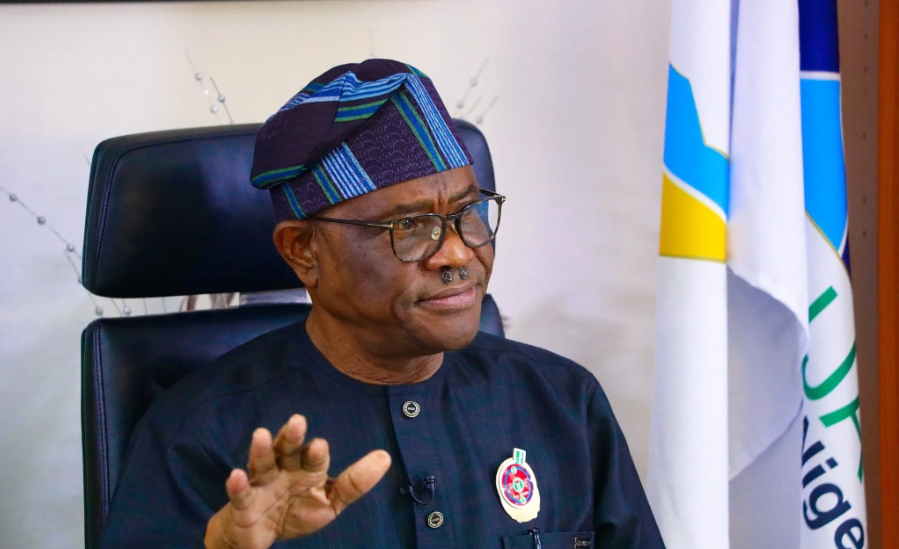
The Minister of the Federal Capital Territory, Nyesom Wike said the biggest mistakes made by Governor Siminalayi Fubara were attempting to govern without the support of the political structure that brought him to power and trying to establish an independent political base too soon after assuming office.
According to Wike, Fubara began making moves to build his own political structure less than 100 days after taking office, a development he described as premature and a clear indication that the governor underestimated the political alliance that facilitated his emergence.
The former Rivers State governor made the remarks during a special media chat in Port Harcourt on Saturday, where he spoke extensively on the political crisis that has engulfed Rivers State since 2023 and his deteriorating relationship with his successor.
Wike maintained that he handed over a stable administration with ongoing infrastructure projects and a clear development blueprint, expecting Fubara to consolidate on the achievements rather than abandon the political structure that supported him.
He disclosed that one of his major priorities before leaving office was positioning Rivers State to compete with Lagos in infrastructure, urban renewal and economic development.
According to him, his administration initiated several legacy projects, including the multi-billion-naira Port Harcourt Ring Road, which links several local government areas and was already under construction before he left office.
He also highlighted the construction of 12 flyovers across Port Harcourt and Obio/Akpor, describing them as transformative projects that significantly improved traffic flow, enhanced the city’s aesthetics and boosted economic activities.
Wike argued that continuity in governance is essential for sustainable development, stressing that succeeding administrations should build on inherited projects instead of allowing political differences to derail long-term development plans.
Reflecting on the political crisis, Wike said politicians must exercise caution in choosing advisers, warning that many individuals who appear supportive often pursue personal interests.
He alleged that shortly after Fubara assumed office, some politicians who had opposed his emergence began influencing the governor against him, encouraging him to distance himself from those who played key roles in his election.
Also Read: Nyesom Wike and falling rafters of Rivers
“In politics you have to be careful. There are those who genuinely want you to succeed and there are those who simply want to use you for their own agenda,” Wike said.
He explained that before handing over power, he urged Fubara during a church thanksgiving service to focus on governance and continue the developmental agenda already initiated, particularly projects aimed at making Rivers one of Nigeria’s most competitive states.
According to Wike, rather than concentrating on governance, Fubara became distracted by political calculations and advice urging him to assert total independence from his predecessor.
The FCT minister insisted that Fubara’s greatest political error was believing he could govern successfully without the support of the political family that secured his election.
He further dismissed allegations that he demanded money from the Rivers governor, describing the claims as a familiar tactic often deployed whenever political allies fall out.
Wike questioned why he would seek financial support from Rivers State while overseeing the Federal Capital Territory, which operates one of the country’s largest sub-national budgets.
He noted that the FCT administration has recorded remarkable improvements in internally generated revenue, revealing that monthly revenue increased from about ₦8 billion when he assumed office to approximately ₦40 billion under his leadership.
According to him, the increase reflects deliberate reforms, improved revenue collection mechanisms and a results-driven approach to governance.
The former governor maintained that his only expectation was for Fubara to stabilize Rivers State politically, continue ongoing projects and preserve the development momentum established by his administration.
The relationship between Wike and Fubara, once political allies, deteriorated only a few months after Fubara assumed office in May 2023. The disagreement eventually triggered one of Nigeria’s most prolonged political crises, leading to divisions within the Rivers State House of Assembly, legal battles, impeachment threats, protests by supporters of both camps and repeated interventions by the Presidency.
President Bola Tinubu brokered a peace agreement in December 2023 in an effort to restore stability. However, the truce failed to end the political tensions, with disagreements continuing over the control of the state’s political structure, the legislature and local government administration.
The crisis has continued to dominate Rivers politics, slowing policy implementation, creating uncertainty over governance and drawing nationwide attention because of Rivers State’s strategic importance as one of Nigeria’s largest oil-producing states.
Despite the prolonged disagreement, Wike reiterated that his interest remains the stability and development of Rivers State, insisting that continuity in governance is crucial for sustaining infrastructure growth and attracting investment.
PUNCH