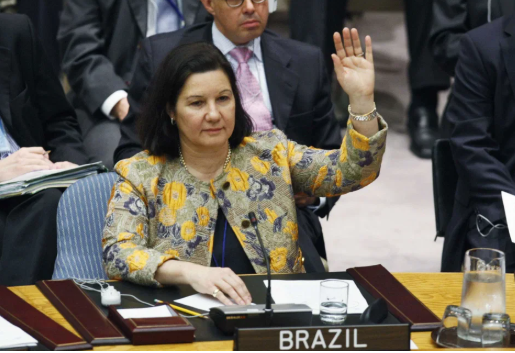
The Trump administration has revoked the visa of Brazil’s ambassador to the United States, Maria Luiza Ribeiro Viotti, escalating diplomatic tensions between Washington and Brasília.
The U.S. State Department said the move was a reciprocal action over Brazil’s delay in granting diplomatic approval, known as agrément, for Daniel Perez, President Donald Trump’s nominee for U.S. ambassador to Brazil.
The dispute comes amid broader tensions between the two countries, including disagreements over visas and concerns about electoral interference.
The State Department did not declare Viotti persona non grata, and a senior department official said the visa cancellation did not amount to expelling her from the United States.
The official said Viotti’s visa would be immediately restored if Brazil grants agrément to Perez. If Viotti leaves the United States, however, she would need to reapply for a visa before returning, according to another senior State Department official.
The Brazilian government condemned the decision, saying it strongly objected to the U.S. action and rejected the reasons given for the visa revocation.
“Today’s decision is not an isolated incident. It forms part of a deliberate escalation of hostile measures against Brazil, driven by ideological motives that are incompatible with a bilateral partnership that has always been guided by mutual respect,” Brazil’s presidency said in a statement.
The dispute comes ahead of Brazil’s October presidential election, in which President Luiz Inácio Lula da Silva is expected to face Flávio Bolsonaro, son of former President Jair Bolsonaro. Flávio Bolsonaro met with members of the Trump administration, including Trump, earlier this year.
Lula said last month that Brazil had refused visas to two U.S. State Department officials over concerns about potential interference in the country’s elections.
Also Read: Trump administration expands visa arrest campaign
The Brazilian presidency repeated those concerns again, saying the U.S. officials had planned to visit Brazil to question the integrity of its electoral system.
The first senior State Department official disputed that characterization, describing the planned visit as routine. “We respect the Brazilian people in whatever government they choose freely through free and fair elections in Brazil,” the official said.
The official did not rule out further “reciprocal actions,” but said the current dispute was specifically linked to Perez’s nomination.
“We have a well-qualified ambassadorial nominee, and we think the government of Brazil owes us a prompt and positive answer to our request for agrément,” the official said.
According to the official, Brazil has indicated that it may not grant approval until after the October election, potentially preventing Perez from taking up the post even if the U.S. Senate confirms his nomination.
A second senior State Department official said Washington had been in continuous communication with Brazil for weeks and had given the government “every opportunity to do the right thing,” but accused it of repeatedly delaying the process. “We reject any effort by foreign countries to interfere in our domestic processes,” the official said.
Perez’s nomination was submitted to the U.S. Senate on June 1 and approved by the Senate Foreign Relations Committee in late July.
Under normal diplomatic practice, a country typically seeks agrément from the receiving state before publicly announcing its ambassadorial nominee. It remains unclear whether Washington sought Brazil’s approval before announcing Perez’s nomination.
Brazil said that the United States had publicly announced Perez’s nomination before formally submitting its request for agrément.
The Brazilian government also said there was no deadline for granting agrément and that the U.S. request remained under review.
CNN