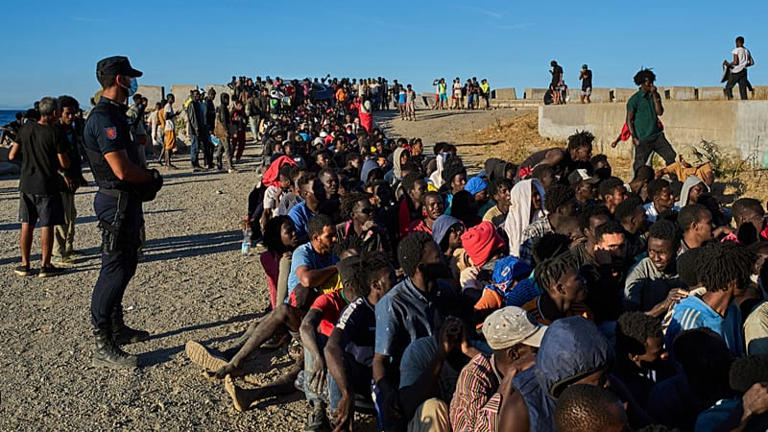
Moroccan prosecutors have charged 86 people in connection with last Thursday’s mass crossing of migrants into the Spanish territory of Ceuta.
The charges include organising illegal border crossings, transporting passengers without a license, overcrowding vessels, overstaying visas, insulting and assaulting security forces, and deliberately damaging public property. The Moroccan news outlet Hespress reported the developments this week.
On Monday, the Moroccan government denied that it had given in to “pressure or blackmail” during the crisis – which saw tens of thousands of migrants enter Ceuta – while expressing its “disappointment” at the reactions of several European leaders, accusing them of trying to use the migration crisis for domestic political gains.
Moroccan diplomatic sources also rejected claims that the country had eased border controls. Speaking to Spanish media, they insisted that anyone attempting to cross the border “knows that they will be sent back and that Morocco will accept their return”. It is a commitment they said Rabat had upheld “for years.”
Meanwhile, the Moroccan Association for Human Rights said this week that Moroccan authorities have prosecuted 52 people in the city of Nador over their alleged involvement in the recent crisis.
Also Read: 57 die as migrants rush to Spain
According to a statement from the organisation, 11 young people appeared before the Criminal Division of the Court of Appeal in Nador, while another 41 people have been brought before the city’s Court of First Instance.
All remain in pre-trial detention and some face accusations of criminal offences, although AMDH has not specified the charges against them.
The Spanish government’s delegate in Ceuta, Miguel Ángel Pérez Triano, has warned that if the autonomous communities refuse to take in migrant minors arriving from Ceuta, the juvenile prosecutor’s office will step in on its own initiative, stressing that «the law must be respected».
In an interview with Cadena SER radio, Pérez Triano said the authorities do not know the exact number of minors living on the streets of Ceuta, though the city estimates the figure at around 500. He noted that the immediate priority is to remove them from this situation.
«Unaccompanied minors must be cared for within Spain. That is what the law states, and it must be applied», he said.
The Spanish official stressed that solidarity among the different autonomous communities is needed so that these minors can be transferred to other regions better equipped to care for them. He underlined that Ceuta is «under enormous pressure» and can no longer absorb all the cases.
For his part, First Deputy Prime Minister and Economy Minister Carlos Cuerpo expressed hope that the government would not be forced into any legal or judicial dispute over the implementation of this obligation, emphasizing that the law requires the autonomous communities to receive the minors.
Africa News