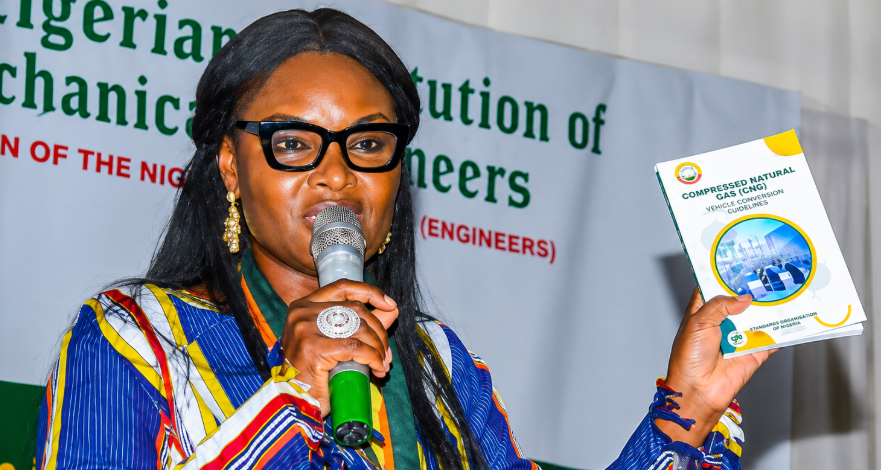
A former National Chairperson of the Nigerian Institution of Mechanical Engineers, NIMechE, Mrs. Funmilade Akingbagbohun, has called for stronger safety measures to support the Federal Government’s expanding Compressed Natural Gas, CNG, programme.
Akingbagbohun made the call in an interview with the News Agency of Nigeria on Sunday in Lagos, while commending the progress recorded in the deployment of CNG as an alternative fuel, and said the expansion of CNG adoption must be accompanied by stronger engineering quality control, professional competence, infrastructure and effective data management to ensure the programme remains safe and sustainable.
According to her, Nigeria has an opportunity to build a reliable Compressed Natural Gas ecosystem by strengthening inspection, certification and monitoring systems as more vehicles are converted.
Akingbagbohun recommended mandatory national inspection and periodic recertification of CNG-powered vehicles throughout their operating lives.
She proposed the introduction of a digital CNG identity for every converted vehicle, linking it to the vehicle’s identification number, VIN, conversion kit, cylinder, installer and inspection history.
She said inspections should cover cylinder integrity and mounting, expiry dates, high-pressure lines, valves, regulators, pressure-relief devices, leak detection and electrical connections.
The expert also recommended checks on engine management systems, crashworthiness, cylinder clearance, ventilation and the overall quality of installations.
“The vehicle should not simply be inspected once after conversion. There should be mandatory periodic inspection, just as roadworthiness is required,” she said.
The former NIMechE chairperson also advocated a national accreditation and competency system for engineers and technicians involved in CNG conversions.
She said accredited conversion centres should have qualified personnel, certified equipment, calibrated leak-testing and diagnostic tools, approved procedures and emergency-response systems.
She further called for independent audits and periodic inspections to ensure that conversion operators consistently comply with required safety standards.
Also Read: Tinubu restates revival of refineries, CNG expansion
Akingbagbohun also proposed the establishment of a National CNG Safety and Incident Data System to record vehicle conversions, cylinder replacements, repairs, accidents, leaks, fires and component failures.
According to her, such a system would enable authorities to track vehicles, conversion centres, cylinders, installers, inspections and incident histories more effectively.
Akingbagbohun said Nigeria had made significant technical progress in preparing for wider Compressed Natural Gas adoption but noted that more work was required in institutional coordination and enforcement.
“Technically, Nigeria has made significant progress; institutionally and enforcement-wise, I would say there is still room to strengthen the systems as adoption expands,” she said.
She noted that the Standards Organization of Nigeria, SON, had developed standards covering conversion kits, cylinders, electrical connections, diagnostics, vehicle safety and refueling infrastructure.
She urged continued collaboration among SON, the National Automotive Design and Development Council, NADDC, the Nigerian Midstream and Downstream Petroleum Regulatory Authority, NMDPRA, conversion centres, engineers and vehicle owners.
The expert also called for continued measures against the use of uncertified or improperly reconditioned cylinders and other components.
She said the ongoing training of technicians was important to developing the human capacity needed to support the programme, but added that training should be backed by certification and continuous professional development. “For mass adoption, Nigeria needs a structured professional hierarchy,” she said.
Akingbagbohun recommended that qualified engineers take technical responsibility for CNG conversions, particularly those involving commercial fleets and high-capacity vehicles.
Akingbagbohun said CNG could provide sustained savings for motorists if supported by efficient refueling infrastructure, reliable gas supply and proper vehicle maintenance.
She noted that the Presidential CNG Initiative had indicated that CNG could be 40 per cent to 60 per cent cheaper per kilometre than petrol.
She therefore called for the development of CNG corridors with reliable mother and daughter stations, adequate gas supply, backup compression systems, emergency-response facilities and certified conversion centres.
According to her, safety, technical competence, infrastructure and data systems must develop alongside the expansion of CNG vehicle conversions.
“The biggest risk to Nigeria’s CNG programme is not CNG technology itself. It is the possibility that deployment could outpace engineering quality control, inspection capacity, gas infrastructure and professional competence,” she said.
Similarly, Mr. Dele Clinton, Managing Director of Green Conversion and Assemble Ltd., called for continued strengthening of safety standards, licensing requirements and periodic testing of CNG-powered vehicles.
Clinton urged the government to establish clear standards and penalties for conversion centres, alongside a licensing system capable of distinguishing CNG vehicles from petrol, diesel and electric vehicles.
He proposed annual roadworthiness tests and dedicated safety inspection centres through public-private partnerships.
He also called for greater collaboration between the government and private sector on accredited training programmes for engineers and technicians involved in Compressed Natural Gas conversion.
Clinton said Nigeria had engineers and technicians capable of supporting the transition but stressed that continuous training, certification and professional development remained essential.
He added that maintaining CNG affordability alongside effective safety standards and a skilled workforce would help strengthen public confidence in the programme.
NAN