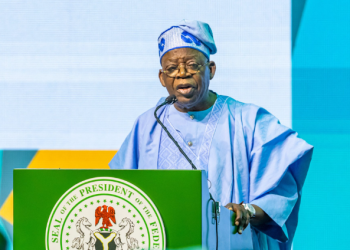
President Bola Tinubu says the Port Harcourt and Warri refineries will return to sustained operations, rejecting concerns about the viability of the government-owned facilities.
Tinubu said the Federal Government was developing a new structural and economic model for the refineries, stressing that rehabilitation would only be meaningful if the plants could operate profitably and deliver value to Nigerians.
Tinubu said this when he received the Executive President of the Nigeria Union of Petroleum and Natural Gas Workers, Salimon Oladiti, and other union members at the Presidential Villa in Abuja, assuring them that “the refineries mentioned are going to come back to work.
He, however, cautioned that restarting a refinery did not necessarily mean it was functioning effectively. “Ordinary flame and smoke of a refinery doesn’t mean it’s working, until it’s profitable and yields the value for which it is built,” the President said.
Tinubu also said he had accepted responsibility for the assets and liabilities inherited from previous administrations and was determined to ensure that the refineries became productive.
“I am not a man who looks back because I have accepted the asset and liability of my predecessor, no matter what has happened in the years past. It is my responsibility now to fix it and make it work for the largest common value of our population,” he said.
The President’s position contrasts with that of former President Olusegun Obasanjo, who has repeatedly questioned the ability of the Nigerian National Petroleum Company Limited, NNPCL, to successfully operate the state-owned refineries.
Obasanjo recently argued that public-private partnerships offered a more sustainable model for managing major government assets.
He cited Nigeria Liquefied Natural Gas (NLNG), where private investors hold a majority stake, as an example of how public assets could be managed more efficiently.
The former president recalled that during his administration, between 1999 and 2007, he approached Shell to take a 10 per cent equity stake in the refineries and operate them.
When the company declined, he said he offered it the opportunity to manage the facilities without taking an equity stake, but the proposal was also rejected.
According to Obasanjo, Shell cited concerns including the limited capacity of the Nigerian refineries, poor maintenance and corruption surrounding their operations.
He also recalled that Aliko Dangote offered $750 million for a 51 per cent stake in two of the refineries during his administration, but the transaction was later reversed by the administration of the late President Umaru Musa Yar’Adua.
Obasanjo said he warned Yar’Adua at the time that the refineries could eventually be worth little more than scrap if the government failed to privatize them.
He further claimed that about $16 billion had subsequently been spent on attempts to rehabilitate the facilities, describing the expenditure as excessive compared with the cost of building new refining capacity.
Also Read: Dangote Refinery seals $2.5b private equity placement
Dangote, who later built Africa’s largest single-train refinery, has also expressed doubts about the government’s approach to rehabilitating the ageing plants.
He argued that modernizing decades-old facilities could create additional technical problems, likening the process to installing a new engine in an old vehicle while leaving its ageing body intact.
Energy expert Dan Kunle has also criticized the continued investment of public funds in the state-owned refineries.
Kunle argued that Tinubu should privatize the facilities and redirect government resources towards sectors such as education, agriculture, gas infrastructure and upstream oil and gas development.
He questioned the information being presented to the President by refinery managers, alleging that some of the advice could be influenced by institutional self-interest.
Kunle maintained that previous administrations had repeatedly attempted to revive the plants without achieving profitable and sustainable operations.
“Because we have passed through that road before, those refineries will never work. If they ever work, they will not work at profit. They will remain problematic,” he said.
He challenged the government to build a new refinery alongside one of the existing plants and operate both simultaneously, arguing that their performance and financial results would expose the weaknesses of the older facilities.
Kunle also questioned why successive administrations had failed to deliver on repeated promises to revive the refineries.
He urged Tinubu to consider privatization and use public funds that would otherwise be committed to the plants to develop other areas of the economy.
Despite the concerns raised by some stakeholders, the Port Harcourt Refinery Host Community Bulk Petroleum Retailers Association has backed Tinubu’s efforts to revive the facility.
The association said it would work towards doubling the votes Tinubu received in Rivers State in the 2023 presidential election if the Port Harcourt refinery becomes fully and sustainably operational before the 2027 general election.
The group said the refinery’s revival would have significant economic and political implications for Rivers State by creating jobs, supporting businesses and strengthening local economic activity.
According to the association, more than 200,000 people depend directly or indirectly on the refinery and businesses linked to its operations.
It also expressed support for the proposed technical equity partnership between the NNPCL and Chinese companies for the rehabilitation and expansion of the facility.
It urged stakeholders to ensure adequate crude supply, effective management, proper maintenance and the technical capacity required to keep the refinery operating sustainably.
The competing positions underscore a major challenge for the Tinubu administration: whether the billions of naira and dollars spent over the years on Nigeria’s ageing refineries can finally translate into reliable and commercially viable domestic refining capacity.
The Conclave