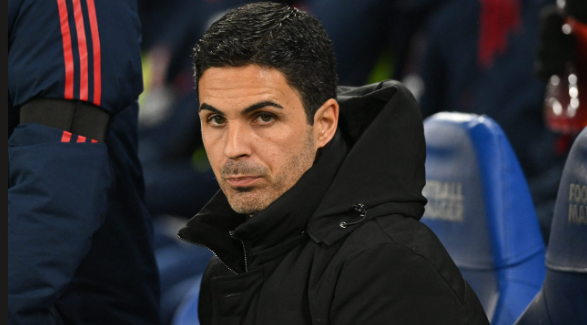
Arsenal manager Mikel Arteta has admitted that the club could make difficult decisions over the futures of some of its long-serving players, insisting that such discussions must be approached with honesty, transparency and mutual respect.
Arteta made the remarks while speaking ahead of Arsenal’s Premier League opener against Coventry City, as the club continues to reshape its squad for the new season, acknowledging that parting ways with established players could be difficult, particularly those who have spent several years at the club, but stressing that such decisions are sometimes necessary in football.
“It’s a really, really tough moment, you need to face that reality,” Arteta said in a statement published on Arsenal’s official website.
He explained that players deserved to know the truth about their situations, even when the information might be difficult to accept.
“You might not like what you’ve been told, but if it’s truthful, if it’s the reality, if it’s honest and it’s going to help you to make better decisions and have more clarity for the next steps in your career, you have to do that,” he said.
Arteta said communication between the club and players should work both ways, particularly when a player no longer feels important to the team or believes it is time to pursue a new challenge. “These are always very difficult conversations, but they need to be done,” he said.
The Arsenal boss added that the club would seek to maintain its relationship with players even when their time in north London comes to an end. “We all know everything has a start and has an end,” Arteta said.
“When it comes to an end, I think our duty, our responsibility is to do it in the best possible way, maintaining the respect and admiration for the player and the relationship, but understanding that at the end, we need to make football decisions.”
Arteta’s comments come as Arsenal continue to adjust their squad while seeking to compete for the Premier League title and other major honours.
The manager rejected suggestions that Arsenal were simply a poor club when it comes to selling players, arguing that transfers depend on several factors, including a player’s quality, contract situation and personal desire to leave. “It’s not bad or good. It depends on what you have relative to the options you have to sell,” he said.
Also Read: Arteta Gabriel signs scholarship deal with Arsenal
According to Arteta, there can also be situations where the club wants to move a player on but the player is happy at Arsenal and has no desire to leave.
“A possible issue that you can face is that maybe you want to make certain decisions with certain players, but they are happy and want to stay as well,” he said.
“There are a lot of factors that have to be right when you have to sell a player, but it’s not that simple, in my opinion.”
The Spaniard also dismissed the idea that Arsenal must necessarily sell players before making further additions to the squad.
He pointed to the club’s growth in value, performances and revenues as evidence that Arsenal had increased their financial and sporting capacity.
“I think there isn’t any club in Europe that has had the growth that Arsenal had in terms of the value, in terms of the performances, in terms of the revenues,” Arteta said.
He added that while some clubs may need to sell before buying, Arsenal were taking a different approach because of the growth achieved in recent years.
Despite the possibility of departures, Arteta said he wanted to maintain a strong and competitive squad, particularly given the demands of the season.
He stressed that players needed to feel important and valued, while also receiving sufficient playing time.
“The players have to feel important and valued and in order to do that, they need to play minutes,” he said.
Arteta also highlighted the importance of players who have progressed through Arsenal’s academy, describing them as particularly valuable to the club because of their connection with the institution.
He said academy graduates often bring a special relationship with the club that is difficult to replicate through transfers.
“There is no question about that, and we need to look after them in a really special way because they bring value that is very difficult to find,” Arteta said.
He added that Arsenal would continue to protect, develop and maximize the potential of players who had been raised within the club’s system.
Amid speculation surrounding the futures of some players, Arteta confirmed that young defender Myles Lewis-Skelly would remain an Arsenal player when the transfer window closes. Asked whether Lewis-Skelly would still be at the club, Arteta responded: “100%.”
The manager also confirmed that Arsenal were looking to strengthen their defence following William Saliba’s long-term injury. “The ambition is to improve the squad,” he said.
“We have a really specific issue in the backline, especially with the long-term injury of Wilo [Saliba] and the fact that we miss one more defender; that’s clear.”
Arteta said the club was working to address the defensive shortage and would announce any new signing when the process was completed.
Although Arteta did not identify any specific player as being at risk of leaving, Bukayo Saka currently stands as Arsenal’s longest-serving first-team player among those highlighted, having made his senior debut in November 2018.
Fellow academy graduate Reiss Nelson has also been part of the senior setup since 2017, although his development has included several loan spells away from the club.
Brazilian forward Gabriel Martinelli is the next longest-serving external signing, having joined Arsenal in July 2019.
Defender Gabriel Magalhães, who arrived from Lille in August 2020, is another established member of the squad and has become a key figure in Arsenal’s defence.
With the transfer window still open, Arteta’s comments indicate that the club could make further changes to its squad while balancing the need for competitiveness with the long-term development of its players.
PUNCH