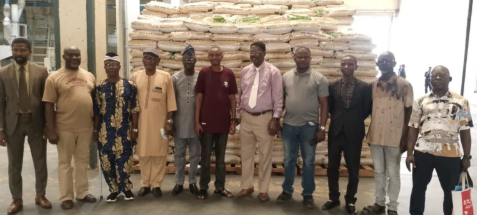
The Lagos State Rice Mill in Imota is facing a shortage of rice paddy that is limiting its ability to operate at full capacity despite having functional equipment, experienced workers and two production lines.
The mill’s Director, Mr. Jacob Akinsanya disclosed this during a courtesy visit by the Nigerian Association of Technologists in Engineering, NATE, to the facility in Imota, Lagos.
Akinsanya, who was represented by the Deputy Director of Engineering and Production, Mr. Hassan Oladipo, said the shortage of raw materials remained the major challenge affecting sustained production at the facility.
He explained that the mill had the manpower and technical capacity required to produce large quantities of rice but could not operate optimally without a steady supply of paddy.
The News Agency of Nigeria reports that rice paddy refers to harvested rice grains that are still enclosed in their husks and require processing before they become the polished rice commonly consumed.
Akinsanya said the shortage of paddy forced the mill to suspend production between April and May 2026, despite its significant processing capacity.
“This facility has an experienced workforce, but the shortage of raw materials forced it to halt production between April and May 2026,” he said.
According to him, the facility, which commenced operations in 2023, has two production lines, with each line capable of processing about 300 tonnes of rice daily.
This gives the mill a combined production capacity of approximately 600 tonnes per day when both lines operate at full capacity.
Akinsanya said the facility had the potential to process rice paddy produced across the South-West if farmers and suppliers could provide sufficient quantities of the raw material.
“If this facility operates optimally, it could process raw materials if rice is planted across the entire South-West,” he said.
He explained that the mill uses a continuous drying system, making a regular supply of paddy essential for maintaining a stable and efficient production cycle.
The director said the facility requires about 5,000 tonnes of paddy to sustain production for two weeks. Transporting such a quantity, he added, would require approximately 200 trailers.
He attributed the shortage largely to declining rice production and insecurity in some parts of the country, which have affected both farming activities and the movement of agricultural produce.
According to him, insecurity has made it more difficult for farmers to cultivate rice and for suppliers to transport paddy from production areas to the mill.
Akinsanya also explained that restarting the facility after a prolonged shutdown comes with additional operational challenges.
Also Read: FCCPC fingers price manipulation in local cement market
He said the machinery requires about three to four days to stabilize after a shutdown before full-scale production can resume.
He noted that frequent interruptions therefore affect efficiency and make it more difficult for the facility to maintain consistent output.
Despite the challenges, Akinsanya said the mill’s machinery remained in good working condition and that inadequate raw materials, rather than equipment failure, was the primary obstacle to sustained production.
He added that efforts were also being made to address electricity supply challenges through the establishment of a dedicated power line for the facility.
According to him, a more reliable electricity supply would further improve the efficiency and consistency of production once adequate paddy becomes available.
Akinsanya maintained that the mill had the potential to meet the rice requirements of several states if sufficient quantities of paddy were made available for processing.
He said expanding access to raw materials would enable the facility to increase production and contribute more significantly to food availability across Lagos and other parts of the South-West.
Speaking during the visit, the National General Secretary of NATE, Mr. Kayode Ibidapo, said the association was at the facility to assess its production process and identify areas where it could offer technical and professional support.
Ibidapo described rice as one of Nigeria’s major staple foods and stressed that increasing local production and processing was essential to improving food security.
He commended the management of the facility for its equipment, workforce and production capacity but expressed concern that the shortage of paddy was preventing the mill from operating at its full potential.
He called for stronger collaboration among the Lagos State Government, agricultural agencies, farmers and other stakeholders to improve access to rice paddy.
Ibidapo also urged the government to increase investment in rice cultivation and make more land available to farmers, particularly in areas with the potential to support large-scale production.
“Increased investment in rice production will provide the raw materials required to keep the mill running and enable it to supply rice beyond Lagos to other states,” he said.
He described the facility as one of the largest rice mills in Africa and said its capacity could make a significant contribution to food production across the South-West if the major challenges affecting its operations were addressed.
“This facility is the largest in Africa and it is capable of producing food for the entire South-West if given the right attention,” he said.
The NATE official further called for stronger measures to tackle terrorism, banditry and kidnapping, which he said were disrupting farming activities and the transportation of agricultural produce.
He said insecurity in farming communities could discourage cultivation while also increasing the difficulty and cost of moving paddy from producing areas to processing facilities.
Ibidapo said the visit had provided the association with a better understanding of the challenges confronting the mill and would guide future areas of collaboration with the government and other stakeholders.
He expressed optimism that greater investment in rice cultivation, improved security and stronger links between farmers and processors would help address the raw material shortage.
He added that sustained collaboration could strengthen rice production and processing, improve food availability and support Nigeria’s broader drive toward food security.
NAN