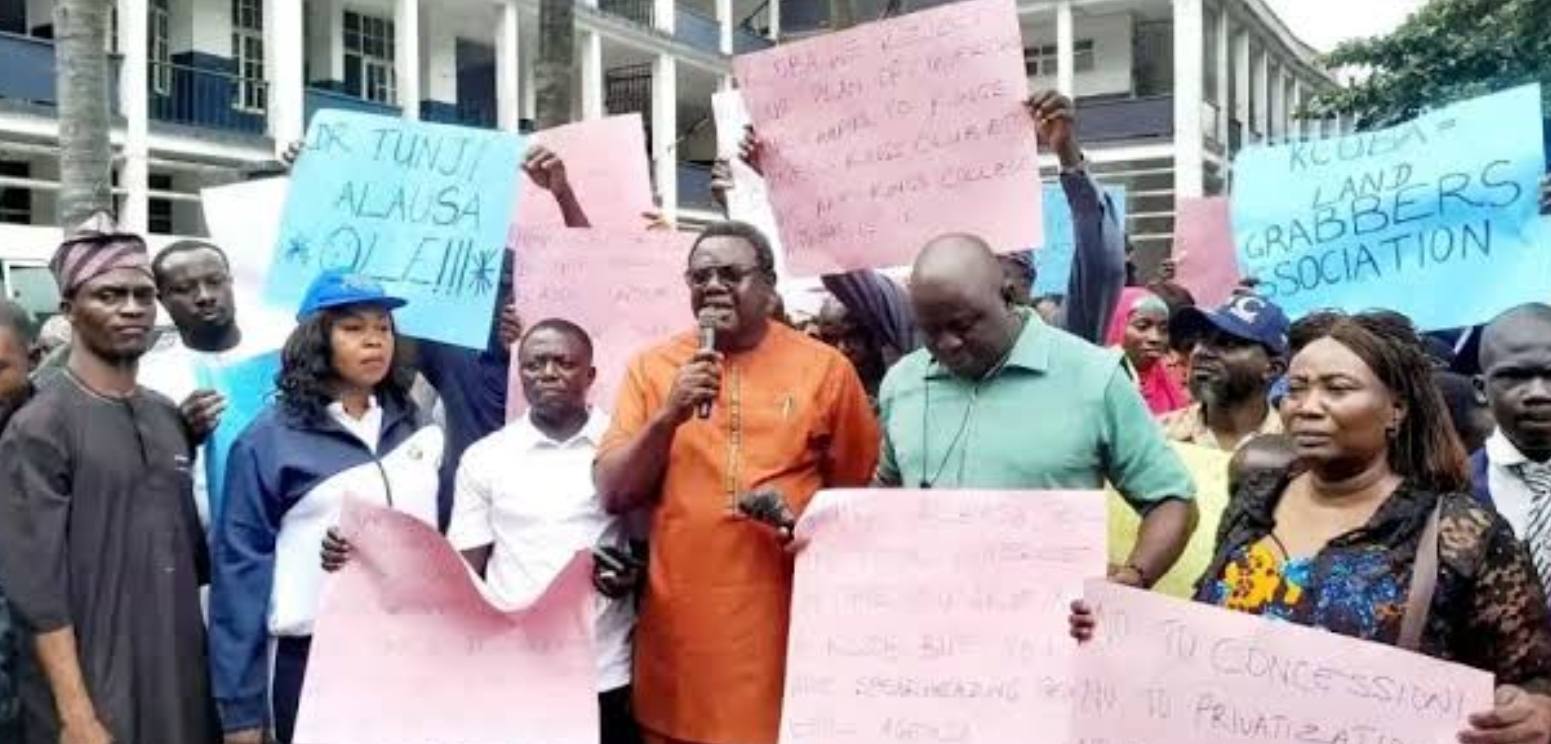
There comes a point in every administration when loyalty to an appointee begins to cost the principal more than the appointee is worth. For President Bola Ahmed Tinubu, that point has arrived in the person of Dr. Tunji Alausa, the Minister of Education, whose tenure — spanning two ministries — has become a case study in how ministerial discretion curdles into ministerial dictatorship.
The immediate provocation is the shutdown of Nigeria’s 115 Federal Unity Colleges, now entering its second week, over the 35-year concession of King’s College, Lagos, to the school’s old boys association. But to treat this as an isolated policy dispute is to miss the pattern. The King’s College debacle is merely the latest exhibit in a troubling dossier of unilateralism.
Exhibit one: Abeokuta. As Minister of State for Health, Dr. Alausa is alleged to have single-handedly installed a personal friend as Chief Medical Director of the newly established Federal University of Medicine and Medical Sciences, Abeokuta. This claim remains unverified in the public record, but what is verifiable is disturbing enough: the Alake of Egbaland, the paramount ruler on whose soil the university sits, is said to have severally submitted recommendations — including a nominee for pioneer Vice-Chancellor — which were brushed aside. A minister who cannot accommodate the counsel of a first-class traditional ruler in a matter touching his domain is a minister who recognises no constituency but himself.
Exhibit two: Akoka. As Education Minister, Alausa raised a Special Visitation Panel to investigate the protracted crisis at the Federal College of Education (Technical), Akoka, Lagos. The panel sat. The panel reported. And then — silence. Till today, the minister has refused to publish the outcome. The concealment has grown so egregious that a lawyer has dragged him to court seeking an order compelling release of the report, while the college itself remains trapped in the very limbo the panel was meant to resolve. A probe whose findings are buried is worse than no probe at all; it is accountability performed for the cameras and aborted in the filing cabinet.
Exhibit three: King’s College. Here the pattern reaches its logical conclusion. The Federal Executive Council approved a 35-year concession of a 117-year-old national monument without publishing its terms, without consulting the unions who run the school, without carrying along the parents who patronise it, and without the courtesy of meeting the Joint Congress of Unions — which sought the minister’s audience for a full month and was refused. When the unions protested, the ministry’s response was not dialogue but a circular branding lawful workers “illegal and unauthorised,” with instructions to principals to summon the police and the DSS against them.
This is not administration. It is rule by decree.
And the cost is no longer abstract. Thousands of pupils who travelled to resume at Unity Colleges from Ebonyi to Abuja to Edo found locked gates and pasted notices: No resumption till further notice. The NUT, ASUU, NLC and TUC are being courted into a widening solidarity front. Parents are preparing litigation. All of it — every stranded child, every lost teaching day — flows from one man’s refusal to do the elementary work of governance: consult, publish, persuade.
The irony cuts deep. The Unity Colleges were founded precisely to bind Nigeria’s fractious federation together — to seat the child of Sokoto beside the child of Owerri in one classroom. In one stroke of opacity, Dr. Alausa has managed to unsettle that spirit of national unity more thoroughly than any secessionist agitation of recent memory. A minister whose legacy is the emptying of 115 campuses is not a reformer; he is a wrecking ball.
President Tinubu should ask himself the question history will certainly ask: who is served by this? Not the pupils. Not the parents. Not the unity of the federation. The King’s College concession may yet prove defensible policy — alumni capital for decaying infrastructure is an argument worth having. But it is an argument that must be had, openly, with published terms and consulted stakeholders — not imposed from a ministerial Olympus.
The President has two choices. He can continue to indulge a minister who governs by circular, buries probe reports, and rebuffs kings, unions and parents alike — and own the wreckage when the courts, the National Assembly and the labour movement converge on his government. Or he can do what presidents are elected to do: checkmate the excess, compel the publication of the Akoka report, suspend the King’s College concession pending genuine consultation, and remind Dr. Alausa that a minister holds delegated power, not imperial prerogative.
The gates of 115 colleges are locked. The key is not in Alausa’s pocket. It is on the President’s desk. He should use it.
Crediblenewsng.com