The Ijaw Youth Council, IYC, Worldwide has rejected any proposal to reroute the Lagos-Calabar Coastal Highway through the East-West Road, insisting that the project must retain its original coastal alignment through Edo, Delta, Bayelsa and Rivers states.
The council warned on Thursday that diverting the highway would undermine the Federal Government’s commitment to the South-South region and have political consequences for President Bola Tinubu and the All Progressives Congress ahead of the 2027 general elections.
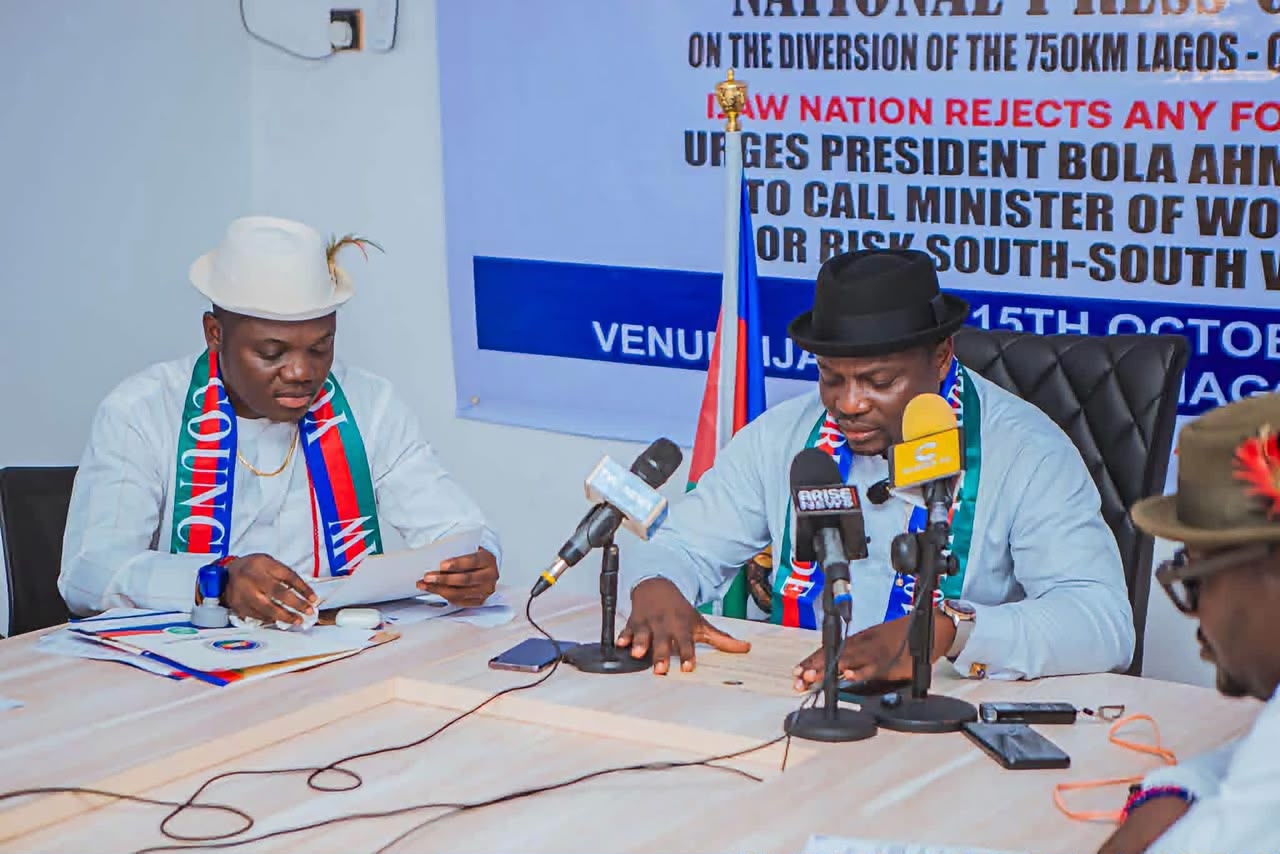
Speaking at a press conference in Yenagoa on October 15, the IYC National President, Doubra Collins Okotete, described suggestions that the highway could be rerouted because of financial constraints and difficult terrain as unacceptable.
“We state here unequivocally that the Ijaw nation and the entire South-South will not accept the diversion of this all-important project under any guise,” Okotete said.
“The excuse of financial constraints or difficulty of terrain ascribed to the Minister is insulting, provocative and unacceptable to us.”
The council was reacting to reports that the Minister of Works, David Umahi, had suggested changing the highway’s route because of construction costs and terrain challenges.
Okotete argued that the South-South, which he said produces more than 85 per cent of Nigeria’s oil and gas wealth, should not be excluded from the coastal highway project on the grounds of cost.
“Our oil must not be used to develop other regions while our region is told that developing our area is too costly,” he said.
To support its position, the council cited several road projects under construction in the region by state governments and the Niger Delta Development Commission.
They include the Nembe-Brass Road in Bayelsa State, which features more than 15 bridges; the Yenagoa-Oporoma-Ukubie Road, with a 630-metre bridge across the Nun River; and the Polaku-Sabagria dual carriageway.
Also Read: FG defends re-routing on coastal highway due to difficult terrain
Others are the Port Harcourt-Okrika Road, which includes the 1.2-kilometre Kaa-Ataba Bridge; the 27.1-kilometre Bonny Ring Road, with 13 bridges; and the 24-kilometre Gbaregolor-Ogolaha Road in Delta State.
The IYC argued that these projects demonstrated the feasibility of building major roads across the region’s challenging terrain.
Okotete also linked the highway project to the political relationship between the Federal Government and the South-South, noting that Bayelsa Governor Douye Diri, Delta Governor Sheriff Oborevwori and Rivers Governor Siminalayi Fubara had defected to the APC.
He said the governors’ moves were partly influenced by expectations of major infrastructure projects, including the coastal highway.
“You cannot seek our votes while taking away our roads,” he said.
The council also dismissed Umahi’s reported subsequent clarification on the proposed route change, describing it as “calculated deceit.”
It demanded the public release of the approved designs and engineering drawings for the entire 750-kilometre highway and called for construction to begin simultaneously along the Edo, Delta, Bayelsa and Rivers sections, alongside the Lagos-Ondo and Cross River-Akwa Ibom sections.
Okotete urged the Federal Government to retain the original alignment approved by the Federal Executive Council, warning that the Ijaw nation would not accept assurances without visible progress.
The council maintained that the coastal highway should proceed along its approved route and called on the Federal Government to demonstrate its commitment by advancing construction across the South-South.
Sahara Reporters