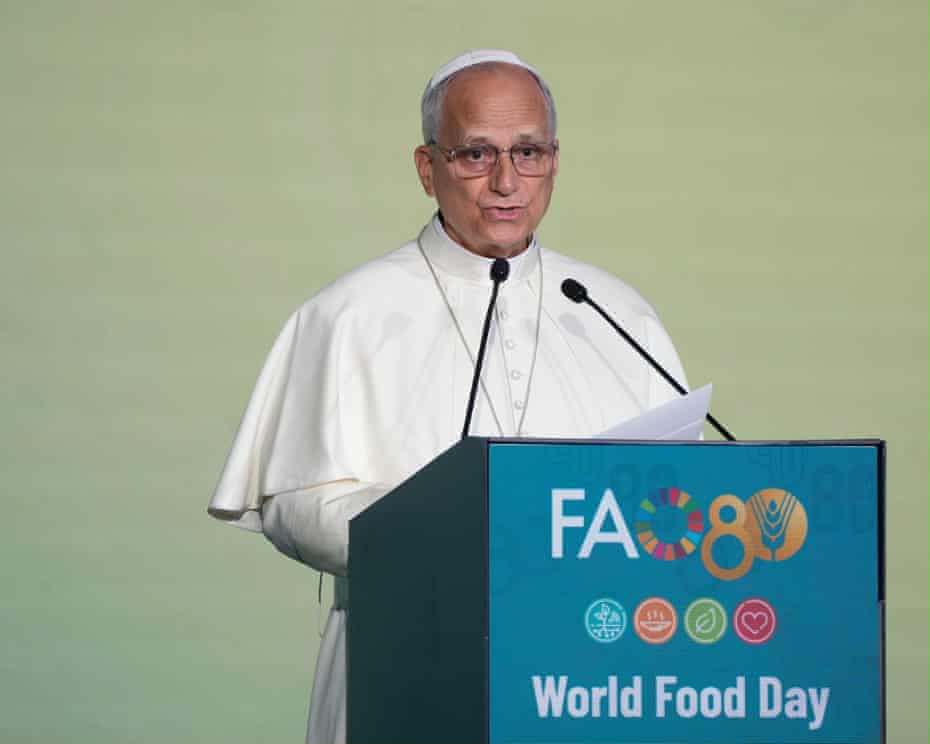
Pope Leo XIV has warned against using food as a weapon of war, a tool of geopolitical pressure or a volatile financial asset, calling for stronger global commitment to ending hunger.
The Pope gave the warning in a message delivered by Monsignor Fernando Chica Arellano, the Vatican’s representative to the Food and Agriculture Organization of the United Nations, at the 2026 World Food Day ceremony.
The Pope said hunger persisted despite advances in technology because of insufficient political will and collective commitment to ensuring access to food.
“In an era of greater technological advancement than ever before, it is intolerable that bread should be considered a privilege rather than a contested commodity,” he said.
He described access to safe, adequate and sufficient food as a fundamental human right, adding that individual states and the international community had an obligation to guarantee it.
The Pope also cautioned against technological innovation driven solely by profit, warning that agricultural practices that depleted soil fertility or displaced farmers should not be regarded as progress.
He called for increased investment in sustainable agricultural research and the restoration of degraded soils, while urging stakeholders to combine modern technology with farmers’ traditional knowledge.
“A new global food order is essential, one in which technological innovation is unconditionally subordinate to respect for God-given human dignity and the universal common good,” he said.
Also Read: Pope Leo XIV in stable condition after lung cancer surgery
He warned that innovation driven by the desire to dominate the earth and exclude vulnerable people could lead to violence and conflict.
However, he said innovation that respected the natural order and promoted justice for hungry people could help secure a better future for humanity.
Earlier, FAO Director-General Qualm Dongyu called for people-centred innovation that farmers and rural communities could access to improve food security, livelihoods and economic development.
Qualm said technologies such as satellite crop monitoring, early-warning systems, smart irrigation and digital platforms were helping farmers manage climate risks, conserve water and access markets and financial services.
“Yet, innovation alone is not enough. Its true value lies in reaching the people who need it the most, and that it will be shared and scaled,” he said.
He noted that a significant gap remained between scientific advances and the technologies available to farmers, urging stronger investment and partnerships to ensure innovations met local needs.
Qualm added that climate extremes, water scarcity and conflict were placing increasing pressure on agri-food systems, making innovation essential to producing more food with fewer resources and strengthening resilience.
He called for collaboration among governments, researchers, producers and communities, stressing that no single institution could deliver the transformation needed to strengthen global food systems.
NAN