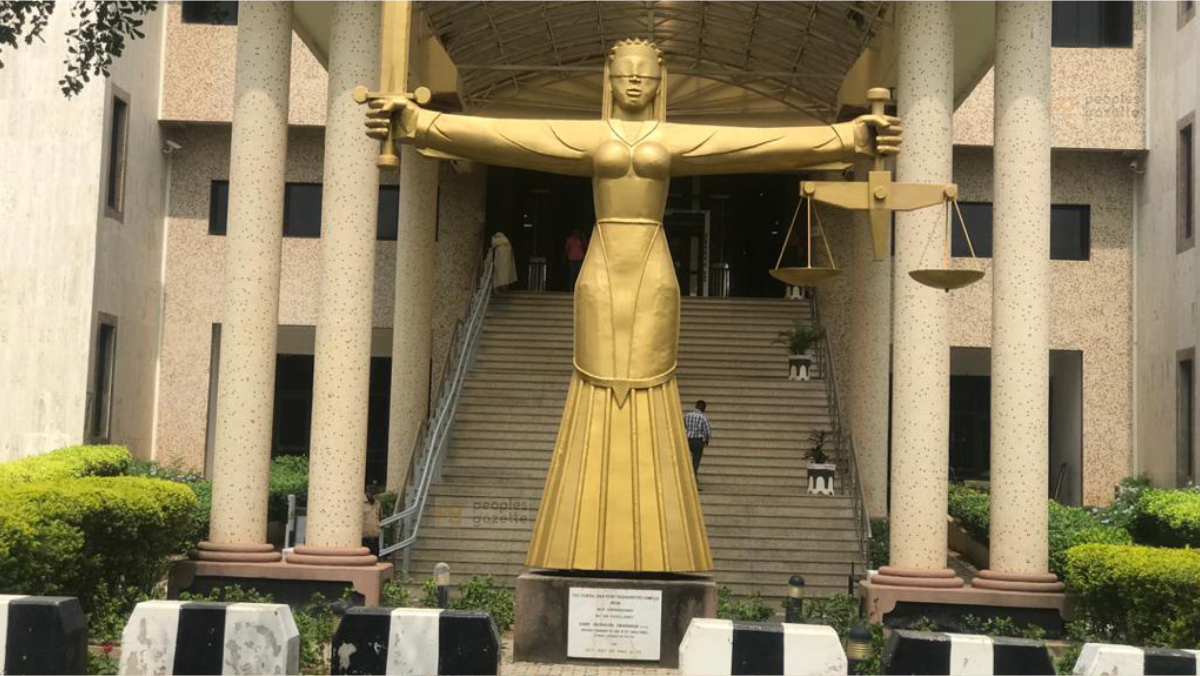
The Federal High Court in Abuja has dismissed a suit filed by Chief Mrs. Chinasa Nwekeke, protem National Chairman of the proposed Wisdom Party, seeking to compel the Independent National Electoral Commission, INEC, to register the association as a political party, barely 88 days to the 2027 presidential election.
Delivering judgment, Justice James Omotosho held that the plaintiff’s claims were without merit and had become academic noting that the association’s application failed to meet statutory requirements and that INEC was within its powers to demand administrative fees for processing party registrations.
Nwekeke had approached the court on behalf of Wisdom Party, arguing that INEC’s silence on her association’s letter of intent amounted to approval of its name, symbol, and acronym.
She challenged the legality of administrative fees imposed under Section 75(6) of the Electoral Act, 2022, describing them as unreasonable and inconsistent with the law, and argued that INEC’s refusal to provide account details for payment was a deliberate attempt to frustrate her association’s application.
The plaintiff sought several declarations, including that INEC’s Fund established under Section 3 of the Electoral Act could not justify levies on political associations, and that the commission’s inaction should be deemed a waiver.
She prayed the court to order INEC to accept Wisdom Party’s application and duly recognize it as properly filed.
Also Read: Court adjourns case between Sirika, EFCC on contract fixing
INEC, represented by counsel Segun Bello, opposed the suit, insisting that the association’s letter of intent was invalid as it did not include a party symbol, a mandatory requirement under the law arguing that granting the reliefs would mean a fresh application less than 12 months to the general election, which contravenes statutory timelines.
In his ruling, Justice Omotosho observed that Section 3 of the Electoral Act allows INEC to generate revenue through accruals, including administrative fees, which can be paid into its Fund.
He explained that institutions funded from the Federation Account are not barred from charging fees for specific services, citing the judiciary’s practice of imposing filing and processing fees despite receiving allocations from the Consolidated Revenue Fund.
The judge concluded that INEC acted lawfully in demanding administrative fees and that the plaintiff’s submissions lacked substance stressing that the association’s defective letter of intent deprived it of any valid claim.
“In final analysis, the claim of the plaintiff is without merit and the suit has become academic. Consequently, the suit is hereby dismissed,” Justice Omotosho ruled
NAN