The All Progressives Congress Presidential Campaign Council on Thursday accused former Vice-President Atiku Abubakar of turning Nigeria’s Ebola emergency into political theatre, insisting that the ₦10 billion approved for preparedness has not been spent.
In a statement signed by its spokesman, Dele Alake, the council said Mr Abubakar’s latest intervention — which questioned how the Presidential Task Force had used the money — “opened with a title linking the President’s first name to Ebola,” and warned that such framing “only risks turning a serious health concern into a vehicle to ridicule the President of the Federal Republic.”
The council said the criticism betrayed “patent ignorance about the virus and why the traveller from Uganda was not detected on arrival at the Abuja airport,” noting that Ebola’s incubation period runs from two to 21 days, with symptoms typically appearing eight to 10 days after exposure, and that an infected person cannot transmit the virus until symptoms develop.
On the money, Mr Alake said the ₦10 billion approved by President Bola Tinubu in June “remains untouched,” and that the Nigeria Centre for Disease Control and Prevention, the Federal Airports Authority of Nigeria and other surveillance agencies had been drawing on existing resources instead. He did not publish disbursement records. The claim could not be independently verified on Thursday.
The council instead praised the surveillance network at Nigeria’s entry points, saying it flagged the index case and led to the tracing of the patient’s 44 contacts. “A responsible opposition will applaud the Task Force for being responsive. But the Atiku camp always goes for cheap shots at the government,” the statement said.
Atiku’s demands
The statement Mr Abubakar issued on Wednesday, through Phrank Shaibu, director of strategic communication of the ADC Presidential Campaign Council, demanded that the government publish “the amount actually disbursed, the dates of payment, every contract awarded, every recipient and every item delivered.”
“Ebola is a grave public health threat. Nigerians deserve urgent action, competent leadership and the truth,” he said, adding: “The NCDC, epidemiologists, doctors and public health professionals must be in charge, with the authority and resources to act. Political titles cannot trace contacts, equip hospitals or save lives.”
He also alleged that 44 identified contacts were left unmonitored for a period and that health workers who treated the patient lacked adequate protective equipment, and he questioned why the case was not confirmed publicly until 20 October.
In the most politically charged passage, Mr Abubakar said he had “confirmed information” that a briefing by the Minister of Health was “intended to discourage Nigerians from attending campaign rallies and, ultimately, from voting.” The APC council called that allegation “speculative,” saying the briefing did not raise the issue but only appealed to the public to comply with protocols announced by the Task Force, and that “Vice-President Atiku cannot make such a serious allegation without verifiable evidence, especially in the thick of electioneering.”
Also Read:WHO supports Nigeria amid Uganda’s Ebola case denial
Meanwhile, the Coordinating Minister of Health and Social Welfare, Prof. Muhammad Pate, has urged political leaders not to politicise Nigeria’s confirmed case of Bundibugyo Ebola Virus Disease.
Pate made the appeal on Thursday at a news conference in Abuja, while providing an update on the imported case confirmed in the Federal Capital Territory.
He said health is a unifying issue that transcends political, ethnic and religious affiliations and that decisions on public health measures, including whether to modify planned large gatherings, would be based strictly on scientific evidence and expert advice rather than political considerations.
“We certainly will encourage them to not politicise a humanitarian and public health issue.
“If there is one issue that will unite Nigerians, it is health, because health has no political party, has no citizenship, has no nationality, has no tribe, no religion. It is a great unifier,” he said.
The minister described attempts by political leaders to politicise the case as unfortunate, saying such conduct fell below the standards expected of statesmen.
He said the government would continue to assess the situation and consult relevant experts before making decisions affecting public gatherings and other activities.
Pate said there was currently no indication requiring changes to planned large gatherings, including political campaigns ahead of the next elections.
“Now, this is a contained single case, and we are diligently working to ensure that it remains so.
“At this moment, there is no indication that requires us to alter the course of large gatherings that have been planned.
“However, if the situation changes, we’ll make a determination, we’ll consult broadly with the right experts and make that determination,” he said.
He emphasised that preventing avoidable deaths must take precedence over political interests, warning that failure to follow sound public health advice could have serious consequences.
“Whatever decisions that will be made will be purely based on public health scientific considerations, evidence, and what is considered the best interest of the Nigerian public.
“We are fortunate that this case is surviving, but any death from this outbreak, if it can be prevented, and we don’t prevent it because of a political consideration, I think we have failed in our duties as public health professionals,” he said.
Pate also urged Nigerians to resist misinformation and rely on verified information from public health authorities, warning that false claims could undermine containment efforts.
He said the confirmed case had tested positive three times, adding that the government would continue communicating verified information while respecting the patient’s confidentiality.
“The truth is, we do have a case. It has been tested three times, and those three times’ tests came back positive,” he said.
The minister urged political leaders, journalists and other public figures to exercise responsibility when communicating about the outbreak.
He warned that misinformation could discourage compliance with public health measures, including isolation and quarantine requirements, thereby increasing the risk of transmission.
Pate recalled Nigeria’s experience with resistance to polio vaccination, saying misinformation had contributed to preventable suffering before collective action helped interrupt wild poliovirus transmission.
He called on social media users to demand evidence for claims about the outbreak and consult trusted sources before sharing information.
“When somebody posts something, ask them for the evidence and use trusted sources,” he said.
The minister also urged media organisations to continue providing accurate information from expert sources, commending their handling of communication about the outbreak so far.
He assured Nigerians that the Federal Government remained committed to providing regular updates through the Nigeria Centre for Disease Control and Prevention (NCDC) and the ministry.
Pate said Nigeria would continue working with state governments, the World Health Organization and the Africa Centres for Disease Control and Prevention to manage the situation.
Background: the outbreak
The World Health Organization classes Ebola as a rare but deadly viral disease spread through contact with the bodily fluids of an infected person showing symptoms. The current outbreak, caused by the relatively rare Bundibugyo species — for which there is no approved vaccine or treatment, though trials are under way — has been running since May.
According to the European Centre for Disease Prevention and Control, cited by the BBC, the Democratic Republic of Congo has recorded more than 9,500 cases and at least 4,600 deaths. Uganda reported at least two deaths before declaring itself free of the disease in August; Kenya has reported at least nine infections.
Nigeria confirmed its first case in more than a decade on Tuesday. The patient, a 42-year-old Ugandan-born woman based in Abuja and the wife of a diplomat, had spent about two and a half weeks in Kampala, Health Minister Muhammad Ali Pate said.
Background: the timeline in dispute
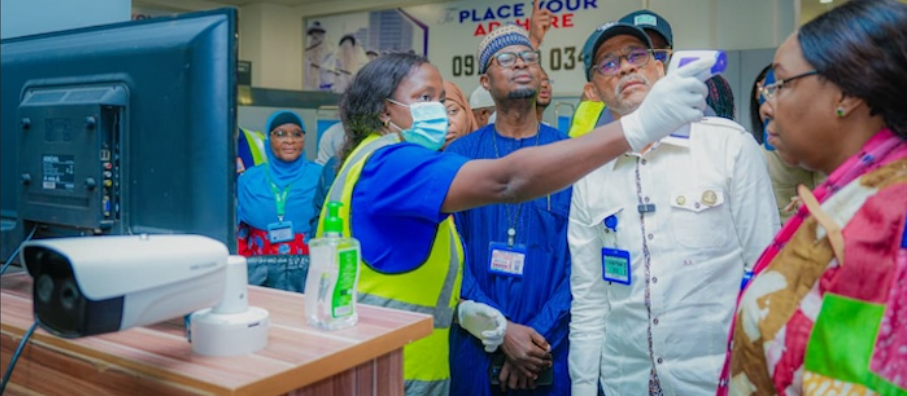
Accounts of the patient’s movements diverge. Dr Jean Kaseya of Africa CDC said she landed in Abuja on 3 October and fell ill three days later; Mr Abubakar’s statement put her arrival at 5 October, with symptoms on 7 October and a first visit to a private hospital on 11 October. Mr Pate said she was admitted on 11 October after being treated for suspected malaria, that public health authorities were alerted on 19 October, and that three laboratory tests confirmed Ebola the following day. She is stable and improving, he said, and none of the 44 contacts — now in isolation — has developed symptoms. Aviation Minister Festus Keyamo said 46 people, including two household workers, have been barred from boarding flights, and screening has been stepped up at international airports.
Background: the politics
The June approval created a Presidential Task Force chaired by the Chief of Staff, Femi Gbajabiamila, with ₦10 billion released to strengthen NCDC preparedness — a structure Mr Abubakar argues puts political appointees rather than health professionals in charge.
The exchange is the second flashpoint between the two camps this week. On Tuesday, the same campaign council denied allegations of a plot to assassinate Mr Abubakar, saying his security detail had not been withdrawn.
With the 2027 general elections approaching and campaign season under way, the outbreak has become a test of how far a health emergency can be separated from electoral contention: the government is asking for compliance with Task Force protocols, while the opposition is asking whether those protocols could shade into restrictions on assembly and voting.
Neither side has called for anything less than containment. “Nigerians deserve, first of all, protection from the deadly disease,” Mr Alake said.
Crediblenewsng.com