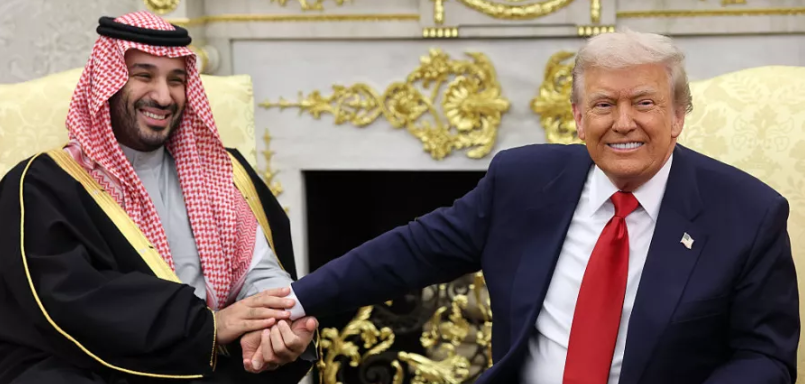
US President Donald Trump has said the proposed civil nuclear agreement between the United States and Saudi Arabia will only proceed if Riyadh recognizes Israel by joining the Abraham Accords.
In a post on Truth Social, Trump said the agreement, which he stressed was strictly for civilian purposes and would not allow uranium enrichment, is “totally subject” to Saudi Arabia joining the US-brokered normalization pact with Israel.
It remains unclear whether the condition is explicitly included in the text of the deal, which has not yet been made public, or whether Saudi Arabia has agreed to it.
“The Civil Nuclear Deal which pertains only to non-military use will be approved, but is totally subject to Saudi Arabia joining the very respected and successful Abraham Accords,” Trump wrote. Saudi Arabia has not publicly responded to Trump’s remarks.
White House Press Secretary Karoline Leavitt said on Thursday that Trump had repeatedly communicated the condition to Saudi leaders.
“He has said if they don’t join the Abraham Accords, the deal is off,” she said. “So we’ll continue to have those conversations with our Saudi counterparts moving forward.”
Trump’s comments follow criticism from non-proliferation experts, who warned that the agreement announced on Wednesday could increase the risk of nuclear proliferation in an already volatile region.
Some Republican and Democratic lawmakers have also expressed concern, although Trump’s Republican Party controls both chambers of Congress, making it unlikely that opponents have enough votes to block the agreement.
According to the US Department of Energy, the deal includes a peaceful nuclear cooperation agreement and a bilateral safeguards agreement.
The department said the agreements would provide the legal framework for a long-term, multi-billion-dollar partnership focused on civilian nuclear energy while advancing nuclear non-proliferation objectives. It added that the agreement would be submitted to the US Congress for review.
The International Atomic Energy Agency, IAEA, said it was aware of the proposed US-Saudi civil nuclear cooperation agreement and plans for the agency to implement verification measures.
“We look forward to receiving the request for such verification and to working with the US and Kingdom of Saudi Arabia, KSA, in ensuring the implementation of those measures,” the agency said.
Also Read: Trump backs Saudi Arabia’s nuclear program
The Abraham Accords, brokered during Trump’s first term, normalized relations between Israel and the United Arab Emirates and Bahrain, marking the first such agreements between Israel and Arab states in decades. Sudan, Morocco and Kazakhstan have since joined the accords.
Saudi Arabia has consistently maintained that it will not normalize relations with Israel without the establishment of an independent Palestinian state. However, the White House has reiterated that the nuclear agreement will not move forward unless Riyadh joins the accords. Israel welcomed Trump’s position.
In a post on X, the office of Prime Minister Benjamin Netanyahu described Saudi Arabia joining the Abraham Accords as “an historic leap forward for peace in the Middle East.”
The statement did not mention the nuclear agreement. However, Israeli Economy Minister Nir Barkat previously said Israel could accept Saudi Arabia developing nuclear energy for peaceful purposes.
Not all Israeli officials share that view. Former Defence Minister Avigdor Lieberman warned that civilian nuclear programmes can evolve into military ones, saying, “Every military nuclear program begins with a civilian one.”
Israel is widely believed to possess nuclear weapons, although it has never officially confirmed or denied having them.
The US has described the agreement as a peaceful nuclear cooperation deal that will expand opportunities for American companies to participate in Saudi Arabia’s civilian nuclear energy programme.
The issue comes amid ongoing tensions involving Iran’s nuclear programme. Tehran has long denied Western accusations that it is seeking to develop nuclear weapons.
Saudi Crown Prince Mohammed bin Salman said in a 2018 interview with CBS News that while the kingdom was not pursuing nuclear weapons, it would do so if Iran acquired one. “Without a doubt if Iran developed a nuclear bomb, we will follow suit as soon as possible,” he said.
Earlier media reports suggested the agreement could eventually allow Saudi Arabia to enrich uranium, a process used to produce fuel for nuclear power plants but which can also be used to develop nuclear weapons. Trump’s latest comments, however, appear to rule out uranium enrichment under the proposed deal.
Rosemary Kelanic, director of the Middle East programme at the US-based think tank Defense Priorities, said it would be unprecedented for Washington to help Saudi Arabia establish uranium enrichment capabilities.
“The US has never done that before. We have never helped another country enrich on their own soil,” she said, adding that countries with domestic enrichment capabilities pose a greater proliferation risk because they are closer to being able to produce nuclear weapons.
BBC