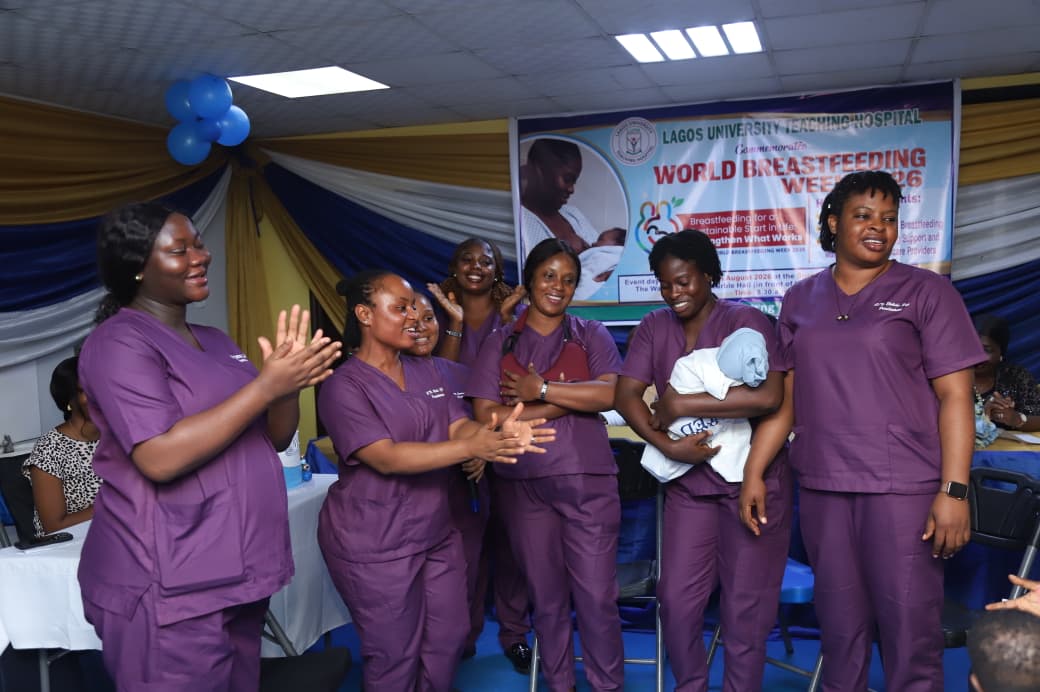
Lagos University Teaching Hospital, LUTH, has called for stronger collaboration among stakeholders to promote effective breastfeeding practices in Nigeria.
The call was made in Lagos during a World Breastfeeding Week 2026 programme organized by the hospital’s Paediatrics Department, with the theme, “Breastfeeding for a Sustainable Start in Life: Strengthen What Works.”
Speaking at the event, the Director of Nursing Hospital Services, LUTH, Mrs Akinola Olajumoke, said the programme was aimed at educating health workers, mothers, families and the general public on the importance of breastfeeding and breast milk.
Representing the LUTH management, Olajumoke highlighted the impact of the hospital’s Baby-Friendly Initiative, which was introduced in 1991, on maternal and child health.
“Breastfeeding event is a week-long programme, and the hospital’s Baby-Friendly Initiative has made great impacts, producing healthy babies for the next generation.
“With the advent of this paternity leave and maternity leave with pay that the Federal Government has introduced, we are really complying.
“If any staff gives birth today, that person is entitled to six months maternity leave with pay, and 14 days paternity leave with pay for the men.
“As a result of that, we are turning out healthier children, healthier neonates. And it doesn’t stop there; even in our labour and neonatal wards, we encourage mothers to breastfeed.
“When mothers come for postnatal visits, we are always very happy that they are really raising healthy babies,” she said.
Prof. Ademola Oremosu, Provost, College of Medicine, University of Lagos, called for holistic support from families, organizations, policymakers and the general public to promote breastfeeding.
Also Read: Mothers champion exclusive breast-feeding
Representing Oremosu at the event, the Deputy Provost, Prof. Daniel Odebiyi, stressed the need for government to develop programmes that support breastfeeding, noting that both mothers and babies require adequate preparation and support.
The keynote speaker, Prof. Abiola Oduwole, described breastfeeding as a strong foundation for lifelong health, development and sustainability, emphasizing the importance of a robust support system for mothers.
Oduwole, a consultant paediatrician in the Department of Paediatrics, LUTH, said the government had a responsibility to protect women from unnecessary reliance on breast milk substitutes by providing conducive and flexible working arrangements, particularly for women in the private sector.
According to her, 12 of the 36 states in the country have adopted the Baby-Friendly Initiative, with Lagos State being the third state to do so.
“Creating a conducive working environment that encourages breastfeeding has become imperative in the face of multiple challenges faced by working-class mothers as they strive to practice exclusive breastfeeding.
“The six months maternity leave given to working mothers in some states and at the Federal level should be applicable in all states of the federation, including in private-sector settings.
“This is because the window period gives ample opportunity for mothers to breastfeed and take good care of the baby.
“For every safe delivery where the mother is alive, healthy and lactating well, there is no reason whatsoever to go for formula or substitutes for breast milk,” she said.
Oduwole urged mothers to adopt the “1:6:24” approach, which involves initiating breastfeeding within one hour of birth, exclusively breastfeeding for six months, and introducing complementary foods alongside continued breastfeeding for up to 24 months.
The Chairman of the occasion, Prof. Edamisan Temiye, stressed the importance of educating mothers about breastfeeding before delivery.
He also noted that breast milk production could be affected when breastfeeding is not initiated and maintained after delivery.
The event featured a panel session where dietitians, paediatricians, nursing mothers and other stakeholders discussed common myths surrounding breastfeeding in Nigeria and proposed solutions to improve breastfeeding practices.
NAN