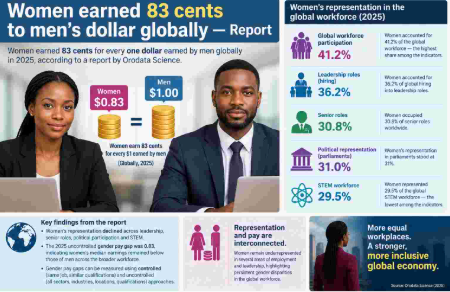
Women earned 83 cents for every $1 earned by men globally in 2025, while their representation remained lower in leadership, senior roles, STEM and political participation, according to a report by Orodata Science.
The Workplace Gender Gap report provides a snapshot of women’s participation in the global workforce, highlighting disparities in employment, leadership representation and earnings. The report was obtained from Orodata Science’s official X handle.
According to the report, women accounted for 41.2 per cent of the global workforce in 2025, the highest figure among the indicators examined. However, their representation declined at higher levels of employment and across other areas of influence.
Women accounted for 36.2 per cent of global hiring into leadership roles, while they occupied 30.8 per cent of senior positions.
Their representation in national parliaments stood at 31 per cent, while women made up 29.5 per cent of the global STEM workforce, the lowest figure among the workforce and representation indicators.
Also Read: NCC launches free data access for educational platforms
On earnings, the report showed that women earned 83 cents for every $1 earned by men globally in 2025, reflecting a continued gender pay disparity. It explained that gender pay gaps could be measured using controlled and uncontrolled approaches.
According to the report, the controlled gender pay gap compares the median salaries of men and women in the same jobs and with similar qualifications.
The uncontrolled gender pay gap, however, compares the median earnings of all men and women across sectors and industries, regardless of location, occupation or qualifications.
The report placed the 2025 uncontrolled gender pay gap at 0.83, indicating that women’s median earnings remained below those of men across the broader workforce.
It said representation and pay were interconnected components of the global gender gap, with women continuing to face lower representation in leadership, political participation and STEM.
The report described the figures as a snapshot of women’s participation in the global workforce and the disparities that persisted across employment, leadership, political representation and earnings.
NAN