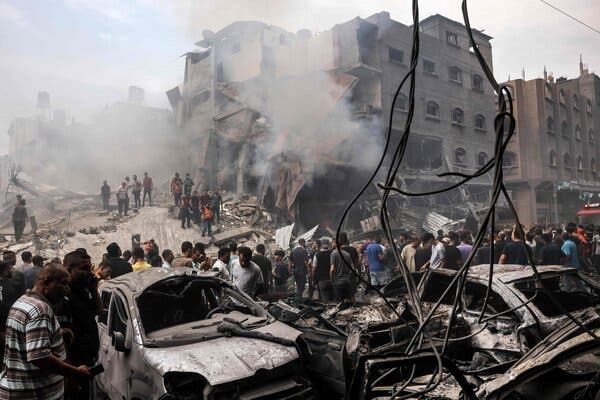
In a desperate bid to escape the relentless Israeli ground campaign, residents of Khan Younis in the Gaza Strip were given an urgent evacuation order, leaving their homes behind as bombs continued to fall on areas designated as safe havens.
The heart-wrenching scene unfolded as Israel’s military marked off approximately a quarter of Khan Younis in yellow on a map, urging residents to flee towards the Mediterranean coast and Rafah, near the Egyptian border. However, the very areas designated for safety became the target of bombardments, adding to the anguish of those desperately seeking refuge.
Israel’s military spokesperson later declared the central road out of Khan Younis as a battlefield, leaving residents with limited escape routes. The western outskirts were granted restricted access, while in Rafah, a brief suspension of military activities allowed some respite until the early afternoon.
The reality on the ground told a different story, with one site in Rafah bearing the scars of overnight bombing—a massive crater, the size of a basketball court, and the lifeless feet of a toddler protruding from the rubble. Distraught men, armed only with their bare hands, struggled to retrieve a child buried beneath the concrete debris.
As the devastated community mourned, they marched through the ruins, chanting “God is Great” and weeping for the innocent lives lost. Salah al-Arja, the owner of one destroyed house, expressed the betrayal felt by residents who were assured of safety: “They tell you it is a safe area, but there is no safe area in all of the Gaza Strip, it is all lies and manipulations.”
The Israeli military blames Hamas for endangering civilians by operating from residential areas, including tunnels that require substantial firepower to destroy. Hamas denies these allegations.
With an estimated 80% of Gaza’s population displaced by the relentless bombing campaign, the once-thriving coastal strip has been reduced to desolation. Medical officials report a death toll exceeding 15,500, with thousands more missing and feared buried under the rubble.
Israel’s military offensive, triggered by a cross-border attack by Hamas on October 7, aimed to annihilate the ruling Islamists. The recent collapse of a week-long truce has led to a swift advance of Israeli forces into the southern half of Gaza, cutting off vital routes and leaving a trail of devastation in its wake.
ISRAEL’S GOALS IN NORTH ‘ALMOST MET’
“The goals in the northern section have almost been met,” said Brigadier-General Hisham Ibrahim, commander of Israel’s armoured corps, to Israel’s Army Radio. “We are beginning to expand the ground manoeuvre to other parts of the Strip, with one goal: to topple the Hamas terrorist group.”
Without specifying the location in Gaza, the military released footage of troops patrolling in tanks and on foot, in fields and in badly damaged urban areas, and firing weapons.
Israel claims its evacuation orders are intended to protect civilians and has asked international organizations to assist in encouraging Gazans to relocate to areas labeled safe on Israeli maps.
According to the UN, the areas in the south that Israel has ordered evacuated in the three days since the truce housed more than 350,000 people before the war, not counting the hundreds of thousands who have fled elsewhere.
Many of those flying out of Khan Younis on Monday had already been displaced from other areas. Abu Mohammed told Reuters that this was the third time he had been forced to flee since abandoning his home in northern Gaza City.
“Why did they eject us from our homes in Gaza (City) if they planned to kill us here?” he asked.
Flames licked the collapsed masonry at a home in Khan Younis that was struck overnight, and grey smoke billowed from the rubble. A sheep stuffed toy from a child lay in a pile of dust. Boys were rummaging through the rubble. Next door, Nesrine Abdelmoty stood in the rented room she shares with her divorced daughter and two-year-old baby.
“We were sleeping at 5 a.m. when we felt things collapse, everything went upside down,” she told the Reuters news agency. “They advised (people) to relocate from the north to Khan Younis because the south is safer.” They’ve now bombed Khan Younis. Even Khan Younis is no longer safe, and even if we move to Rafah, Rafah is no longer safe. Where do they want us to go?”
The United States, Israel’s closest ally, has publicly urged it to do more to protect civilians in the southern part of Gaza than it did in last month’s campaign in the north, especially given the large number of people who are already homeless there.
During the truce, Israel allowed additional humanitarian supplies into the enclave, but the UN says this was paltry in comparison to the territory’s vast humanitarian need, and has now been disrupted by the renewed fighting.
During the cease-fire, Hamas released 105 of its hostages in exchange for the release of 240 Palestinian detainees. However, with the majority of women and children hostages now believed to be free, the truce broke down over terms for releasing more, including Israeli men and soldiers. According to Israel, 136 hostages are still being held hostage.
Mohammed Salem and Roleen Tafakji in Gaza contributed reporting, as did Maayan Lubell, Ari Rabinovich, and Emily Rose in Jerusalem. Maggie Fick in Beirut, Andrew Mills in Doha, Nandita Bose in Dubai, and Idrees Ali, Steve Holland, and Phil Stewart in Washington contributed reporting, as did David Lawder, Lincoln Feast, and Peter Graff.
Crediblenews would like to give credits to Reuters for this coverage of this report. The information and insights presented in this blog post are based on their informative news report.
Crediblenews.ng