South Korean lawmakers impeached the acting president Han Duck-soo on Friday, December 27, amid ongoing political turmoil triggered by his predecessor’s controversial martial law declaration, which had stunned the world.
Han Duck-soo assumed the role of acting president after President Yoon Suk Yeol was suspended following a parliamentary vote on December 3, over his decision to impose martial law.
However, opposition members of parliament demanded that Han, who is also the prime minister, be removed from office. They accused him of neglecting to finalize Yoon’s impeachment and failing to pursue justice for the move.
READ ALSO: South Korean parliament agrees to impeach president
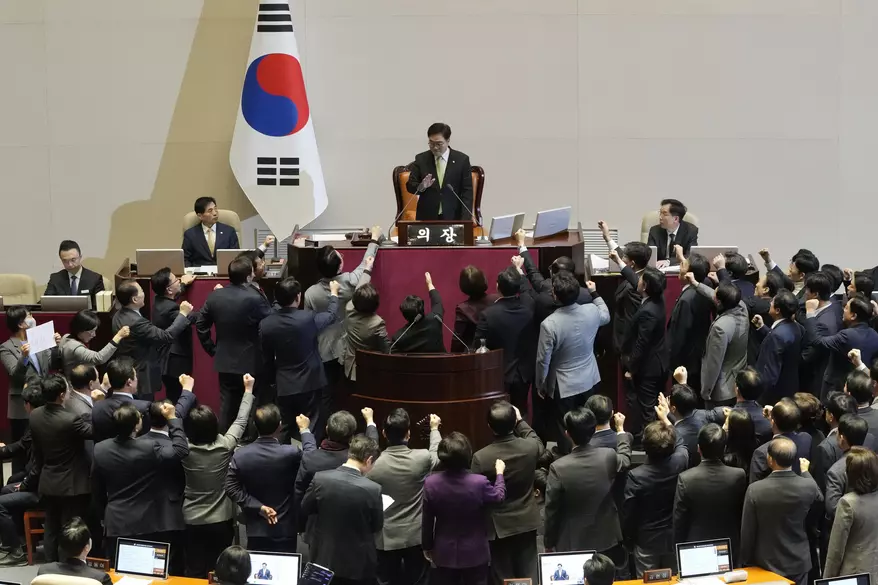
“I announce that Prime Minister Han Duck-soo’s impeachment motion has passed. Out of the 192 lawmakers who voted, 192 voted to impeach,” declared National Assembly Speaker Woo Won-shik.
The vote on the impeachment was delayed as lawmakers from the ruling People’s Power Party, PPP, protested in parliament, objecting to Woo’s claim that only a simple majority was needed in the 300-member parliament to proceed.
PPP members shouted angrily and rushed toward Woo, demanding his resignation. They did not participate in the vote.
This marks the second impeachment of a South Korean head of state within just two weeks, adding to the political instability in the country. It also represents the first impeachment of an acting president in South Korea’s history.
Following the vote, PPP leader Kweon Seong-dong stated that Han “must continue to lead state affairs without yielding to the opposition’s passage of the impeachment motion.”
Han responded afterward, saying he “respects the parliament’s decision” and would await the Constitutional Court’s ruling on whether to uphold it.
In their impeachment motion, the opposition claimed that Han was “deliberately avoiding the special investigation into those involved in the insurrection and had clearly expressed his intention to block the appointments of three Constitutional Court judges.” They argued these actions violated his duty to uphold the law and serve the public.
Finance Minister Choi Sang-mok will assume the role of acting president in Han’s absence. Choi had previously urged opposition lawmakers to reconsider the impeachment motion.
“An impeachment motion against the acting authority is no different from an impeachment motion against the entire cabinet,” he said in a press conference with other cabinet members on Friday.
“Our economy and people’s livelihoods, which are walking on thin ice in a national emergency, cannot bear the expansion of political uncertainty surrounding the acting authority,” Choi added.
The heart of the current dispute centers around the Constitutional Court’s composition, which will decide whether to uphold parliament’s decision to impeach both Yoon and Han.
The court is currently short of three judges, but can still proceed with just six members. However, a single dissenting vote could reinstate Yoon.
The opposition had pressed Han to approve the appointment of three new judges to complete the nine-member bench, but he refused, leaving the two sides in deadlock.
Han’s refusal to appoint the judges “revealed his true colours,” said Democratic Party lawmaker Jo Seoung-lae. “The refusal is a direct challenge to the Constitution and the law,” Jo added, stating that the impeachment was necessary to “restore constitutional order and stabilize state affairs.”
Han, in turn, said he preferred a compromise between his party and the opposition over the nominees. “The consistent principle embedded in our constitution and laws is to refrain from exercising significant exclusive presidential powers, including the appointment of constitutional institutions,” Han argued. “A consensus between the ruling and opposition parties in the National Assembly, representing the people, must first be reached.”
Despite the ongoing controversy, the Constitutional Court held its first preliminary hearing on the validity of Yoon’s impeachment on Friday.
Yoon’s legal team confirmed they would attend the preparatory hearing at 2 pm local time, 0500 GMT.
Meanwhile, the South Korean won fell to 1480.2 per US dollar on Friday morning, marking its lowest point in nearly 16 years. The currency had earlier dropped to a two-year low against the dollar following the martial law declaration, with investors already concerned about the state of the country’s economy.
Police reported on Friday that they had launched a raid on a presidential safe house and were collecting security footage from nearby cameras as part of their investigation into the martial law declaration.
Crediblenewsng.com