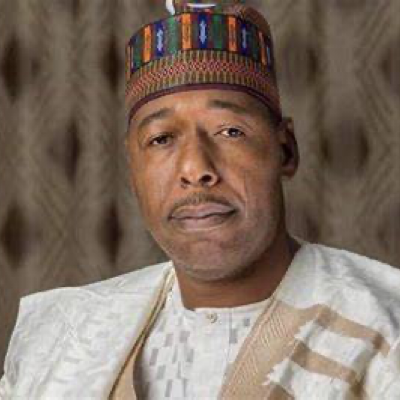
Borno State Governor Professor Babagana Umara Zulum has issued a fresh warning over the escalating security crisis in the state, saying the frequency and intensity of Boko Haram and ISWAP attacks suggest that Borno is once again losing control of key territories.
The governor declared during a Special Expanded Security Meeting convened in Maiduguri on Tuesday. The high-level gathering brought together senior military commanders, law enforcement chiefs, traditional rulers, and Borno State Security Council members.
In attendance were the General Officer Commanding 7 Division of the Nigerian Army, Major General Abubakar Haruna; sector commanders of Operation Hadin Kai; the Borno State Commissioner of Police; heads of intelligence and paramilitary agencies; and traditional leaders, including the Shehu of Borno, Alhaji (Dr.) Abubakar Garbai Al-Amin El-Kanemi. Emirs from Bama, Biu, Uba, Askira, and Gwoza also participated. The Shehu of Dikwa and the Emir of Shani were, however, notably absent.
Zulum, in a strongly worded statement, expressed deep concern over the deteriorating situation, pointing to recent violent incursions by terrorists into several local government areas. He cited the overrunning of military formations in Wajirko and Sabon Gari, Wulgo, and Izge, where both civilians and security operatives have lost their lives.
“It is disheartening to note the recent attacks and dislodgement of military formations,” the governor said. “These attacks, coupled with almost daily kidnappings in various communities, are a clear indication that we are losing ground. This is a significant setback, not only for Borno but for the entire Northeast region.”
He acknowledged the continued efforts and support from President Bola Ahmed Tinubu and federal security agencies, but insisted that more needed to be done, especially in the realm of modern warfare.
“The government must prioritize the deployment of cutting-edge military technology, including drones, surveillance systems, and real-time intelligence gathering tools. We are dealing with insurgents who have adapted and evolved — our response must do the same,” he emphasized.
The Shehu of Borno, in his own remarks, echoed the governor’s concerns and painted an even bleaker picture of the ground reality. He revealed that several areas in Borno remain under the control of insurgents, with no presence of civil authority.
“Guzamala, Marte, Abadam, and parts of Mobbar local government areas are still effectively under terrorist occupation,” he said. “Until we restore government presence in these places, there can be no peace, no governance, and no development.”
The Shehu also made an impassioned appeal to the Federal Government to urgently repair and reconstruct major road networks linking strategic towns and border communities. He listed the Biu-Damboa-Maiduguri, Maiduguri-Dikwa-Ngala, Maiduguri-Monguno-Kukawa, and Biu-Damaturu roads as critical arteries that remain in deplorable condition.
“These roads are essential not only for economic recovery but also for the free movement of security personnel and humanitarian supplies. Their current state hinders rapid response and exposes travelers to ambushes,” Zulum said.
READ MORE: Troops crush terrorists in Zamfara, Borno, Plateau
Zulum warned that unless immediate action is taken, the fragile progress made over the last few years in combating terrorism could be undone.
“We cannot afford to fall back. The people of Borno have endured more than a decade of terror, displacement, and loss. It is our responsibility to ensure they are not forced back into fear,” he declared.
Boko Haram, which began in the early 2000s as a religious movement in northeastern Nigeria, transformed into a deadly terrorist organization around 2009. Its insurgency has led to tens of thousands of deaths and the displacement of millions. In recent years, the group splintered, with a significant faction pledging allegiance to the Islamic State and forming the Islamic State West Africa Province which has grown in strength and territorial ambition.
Despite military offensives, the group continues to carry out deadly attacks, with civilians and rural communities bearing the brunt of the violence. The latest developments in Borno highlight the enduring challenge of restoring stability and civil authority in Nigeria’s embattled northeast.
Crediblenewsng.com