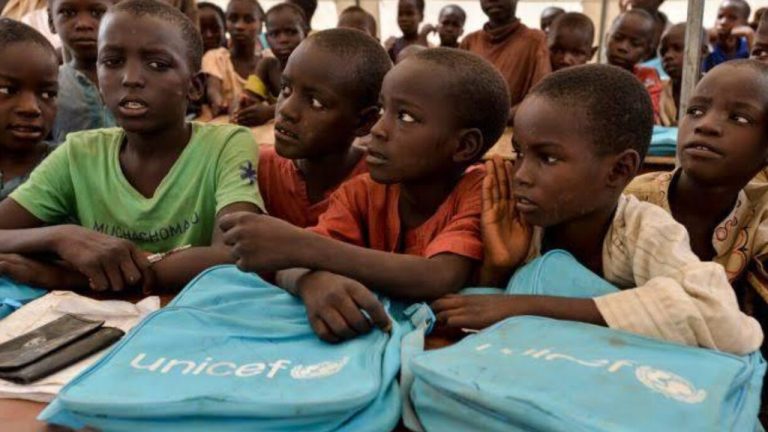
The United Nations Children’s Fund, UNICEF, has expressed deep concern over the education crisis in Nigeria’s North-East region, disclosing that a staggering 72 percent of primary school pupils in Borno, Yobe, and Adamawa States are unable to read after completing their basic education.
This troubling statistic underscores the urgent need for educational reform and increased investment in the welfare of children living in conflict-affected areas.
Speaking during a media briefing, Joseph Senesie, Chief of UNICEF’s Maiduguri Field Office, described the situation as “alarming,” stating that millions of children in the region continue to be denied their basic rights.
He highlighted that the majority of pupils are completing primary school without acquiring foundational literacy skills, a reality that places the future of the region and the nation in jeopardy.
Senesie pointed to other distressing indicators, including the fact that over two million children remain out of school in the North-East.
Furthermore, 12 local government areas in Borno and Yobe States are still struggling with high numbers of unvaccinated children, exposing them to diseases that are otherwise preventable.
The education crisis is compounded by the lack of legal documentation for children. According to UNICEF, only three out of every ten children in the affected states have their births officially registered.
Without legal identification, many of these children are excluded from accessing essential services such as healthcare, education, and social protection programmes.
READ ALSO: Sokoto, UNICEF launch digital training for Almajiri
Despite the grim realities, UNICEF acknowledged some progress. Senesie commended the state governments for initiatives like the implementation of the Child Protection Law, sanitation improvements through open defecation-free declarations, and the establishment of committees on food and nutrition.
He also praised Borno State’s financial commitment to the Child Nutrition Fund, describing these efforts as evidence of political will and leadership.
UNICEF reaffirmed its ongoing commitment to improving child welfare in the region. Senesie reported that in 2024 alone, nearly 600,000 children were treated for severe acute malnutrition in the region.
Additionally, 2.48 million children under five received vitamin A supplements, and 1.2 million children were immunised using the pentavalent vaccine.
In his closing remarks, Senesie urged government agencies, civil society, and development partners to intensify efforts in bridging the gaps in nutrition, healthcare, sanitation, child protection, and especially education.
He emphasized that every child deserves the opportunity to not only survive but also thrive and fulfill their potential.
CenturyPost