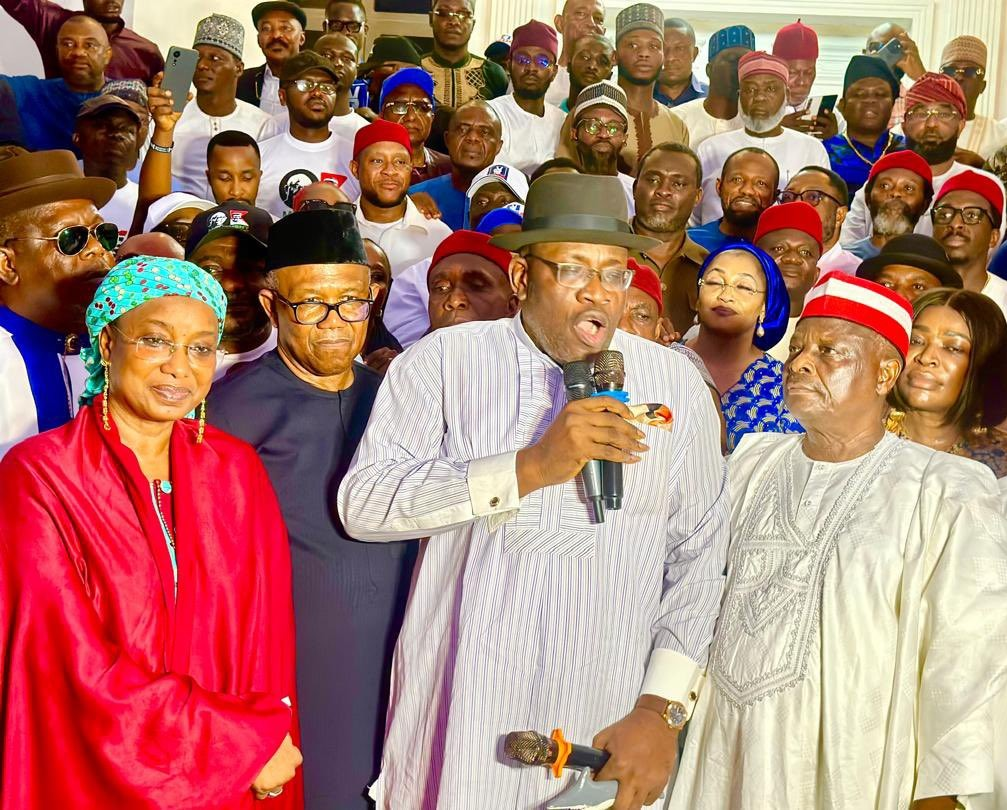
The Nigeria Democratic Congress, NDC, has zoned its presidential ticket for the 2027 general election to Southern Nigeria, a decision that could bolster the prospects of former Anambra State governor Peter Obi and other southern hopefuls seeking the party’s nomination.
The resolution was adopted at the party’s maiden national convention in Abuja on Saturday after Afam Victor Ogene, the lawmaker representing Ogbaru Federal Constituency of Anambra State moved a motion adopted by delegates at the convention.
Party leaders also resolved that the presidential ticket would remain in the South for a single four-year term before returning to the North in 2031.
The decision is significant for Obi, who has emerged as one of the most prominent southern figures in the NDC after formally joining the party alongside former Kano State governor Rabiu Kwankwaso. Both men left the African Democratic Congress-led opposition alliance over internal divisions and legal wrangles, a move analysts said dealt a blow to efforts to build a united opposition front ahead of the next presidential race.
For Obi, the zoning decision aligns with a position he has repeatedly taken on power rotation and equity in Nigeria’s presidential politics. Obi had pressed for zoning during earlier coalition talks and was dissatisfied when the issue was not properly debated, arguing that failure to address rotation and fairness could deepen distrust among stakeholders.
Obi has also left little doubt about his presidential ambition. In June 2025, he said he would contest the 2027 election and declared himself open to serving a single four-year term, while insisting that any coalition he joined must be focused on tackling insecurity, reviving the economy and reducing poverty.
Also Read: Dickson welcomes Obi, Kwankwaso to NDC
The former governor’s political rise to national prominence accelerated in the 2023 presidential election, when he ran on the platform of the Labour Party and built a strong following among young voters and urban Nigerians frustrated with the country’s traditional political elite. His supporters, popularly known as “Obi-dients,” rallied around his message of reform, accountability and a break from the old order.
Although he did not win that race, Obi finished third with about 6.1 million votes, according to the final tally published by the Independent National Electoral Commission. That performance, while short of victory, established him as a major force in national politics and showed his ability to attract support well beyond his South-East base.
Before his 2023 bid, Obi had served as governor of Anambra State and was the vice-presidential candidate of Atiku Abubakar in the 2019 election. Obi has often touted his record in Anambra, where he pointed to a budget surplus at the end of his tenure, should matter more to voters than ethnic or religious identity.
With the NDC now reserving its 2027 ticket for the South, party stakeholders believe the contest for the nomination is set to sharpen around figures such as Obi, whose name continues to loom large in opposition calculations.
Whether the zoning decision will translate into a smooth nomination process — and whether the wider opposition can avoid another fractured race — may prove decisive in shaping the build-up to 2027.
Crediblenewsng.com