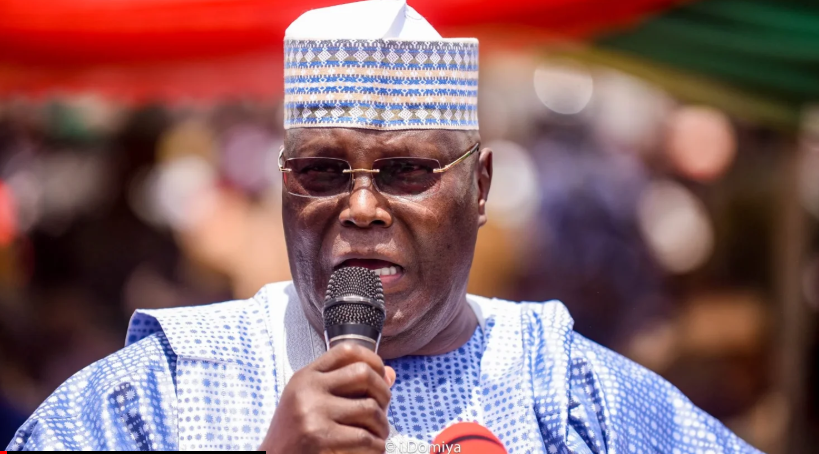
Former Vice President and African Democratic Congress, ADC, presidential candidate Atiku Abubakar has dismissed concerns about his age ahead of the 2027 presidential election, challenging critics to assess his appearance and fitness rather than focus solely on his age.
Atiku made the comments in an interview with BBC Hausa published on Friday while responding to questions about whether his age could affect his ability to provide effective leadership if elected president.
The interviewer pointed out that Atiku would be approaching 80 by the time Nigerians vote in 2027 and asked how he would respond to those who consider his age too advanced for the presidency.
Atiku responded by referring to the age of President Bola Tinubu before challenging the premise of the question. “You went and voted for someone who is 80, I mean 90 years old. How old is President Bola, 90?” he asked.
After the interviewer corrected him, Atiku replied: “Do I look to you like someone who has reached 80 years of age?”
The comments come as Atiku steps up preparations for the 2027 election and continues efforts to build an opposition coalition capable of challenging the ruling All Progressives Congress, APC.
Atiku rejected claims that he had become an obstacle to the opposition coalition, insisting that he played a leading role in bringing the group together.
“That is a baseless accusation levelled against me. I was actually the one who initiated the coalition. Nobody else… I, Atiku Abubakar, started it,” he said.
According to the former vice president, most of the politicians involved in the formation of the coalition remain committed to the project despite disagreements among some opposition figures.
He specifically mentioned Peter Obi and Rabiu Kwankwaso as major opposition figures who had moved away from the group.
Atiku said there remained a possibility of reconciliation before the 2027 election. “Nothing is impossible, by God’s grace,” he said. He added that the opposition could eventually agree to work together in the interest of Nigerians.
Also Read: ADC groups give NWC ultimatum over Adamawa ticket
Atiku also criticized the Federal Government’s handling of the removal of the petrol subsidy. He said he did not oppose the decision to remove the subsidy but questioned how the resulting savings had been used. “I did not oppose the removal of the oil subsidy, but where is the money? Where did it go?” Atiku asked.
He argued that the savings should have been directed towards reducing poverty, improving education, tackling insecurity and creating opportunities for young Nigerians.
The ADC candidate also promised that he would restore the petrol subsidy if elected president. “If elected, I will bring back the oil subsidy, and whoever stole the money must refund it,” he said.
Atiku maintained that the subsidy could have been removed without creating the level of hardship experienced by Nigerians if the savings had been properly accounted for and invested in development.
He said the funds could have been used to address security challenges, strengthen education and create economic opportunities for young people.
Atiku also defended his decision not to sign a proposed peace accord involving opposition politicians. He questioned why the incumbent government was not included in the process, arguing that an agreement involving only opposition parties would have limited value.
“Why is it always only us in the opposition that you bring to sign, but you never bring the incumbent government to sign as well?” he asked.
The former vice president said he saw little reason to participate in the exercise if the ruling party was not also required to commit to the same terms. “So, if you don’t bring the incumbent government to come and sign, I see no point in going to sign it,” he said.
Atiku’s latest comments come as political parties and opposition figures intensify preparations for the 2027 presidential election.
His emergence as the ADC’s presidential candidate and his continued advocacy for opposition cooperation have placed him at the centre of efforts to build a political alternative to the APC.
With the election still ahead, negotiations among opposition politicians are expected to remain a major feature of Nigeria’s political landscape as parties work to determine their candidates, alliances and strategies for the 2027 contest.
PUNCH