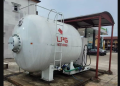
Dangote Refinery has increased the price of Liquefied Petroleum Gas, LPG, commonly known as cooking gas, from N980 to N1,030 per kilogram, adding fresh pressure to household energy costs across Nigeria.
The N50 increase comes as consumers in different parts of the country continue to face significant variations in retail LPG prices, with August 2026 data from 18 locations showing prices ranging from N1,200 to N1,500 per kilogram.
The latest adjustment means a 12.5kg cylinder purchased at the refinery’s new price would cost N12,875 before transportation, distribution and other retail charges are added.
Retail prices, however, remain considerably higher in several locations because of differences in logistics, supply conditions, transportation costs and other market factors.
Data from the 18 locations showed that Sapele and Edo State recorded the highest retail price at N1,500 per kilogram. At that rate, consumers would spend N18,750 to refill a 12.5kg cylinder. The figure is N1,903 above the average price of N16,847.22 recorded across the locations surveyed.
At the lower end of the market, Gwagwalada in the Federal Capital Territory and Ijebu East in Ogun State recorded N1,200 per kilogram, translating to N15,000 for a 12.5kg cylinder.
This means consumers in the two locations paid N3,750 less for the same quantity than those buying at N1,500 per kilogram.
Other locations also recorded substantial price differences. Ojo and Lagos Island in Lagos, Sango Ota in Ogun State, Katsina and parts of Ikorodu recorded N1,400 per kilogram, equivalent to N17,500 for a 12.5kg refill. Jos recorded N1,360 per kilogram, putting the cost of a 12.5kg refill at N17,000.
Meanwhile, Aba, Benin City, Ifo, Karu, Owode Yewa, Sabo in Ikorodu and Shagamu recorded N1,300 per kilogram, translating to N16,250 for a 12.5kg cylinder.
The median price across the 18 locations stood at N16,625 for a 12.5kg cylinder, highlighting the wide gap between the cheapest and most expensive markets surveyed.
The data also showed that consumers can pay markedly different prices for cooking gas even within the same state.
Also Read: Petrol receipts rise as Dangote runs above capacity
In Ogun State, LPG sold for N1,200 per kilogram in Ijebu East, compared with N1,400 in Sango Ota. Ifo, Owode Yewa and Shagamu recorded N1,300 per kilogram.
The N200 difference per kilogram between Ijebu East and Sango Ota amounts to N2,500 on a 12.5kg cylinder, showing the impact of location on the final retail cost faced by consumers.
A similar variation was recorded in Lagos State. Ojo, Lagos Island, Ijede in Ikorodu and Odogunyan recorded N1,400 per kilogram, while Sabo in Ikorodu recorded N1,300.
Such differences are often linked to the cost of moving LPG from supply points to retail outlets, distribution networks, local demand and supply conditions, among other factors.
The latest development comes amid an increase in the cost of cooking gas recorded by the National Bureau of Statistics, NBS.
The NBS LPG Price Watch showed that the average retail price of a 5kg cylinder rose to N8,706.93 during the period under review, from N7,655.73 previously.
The increase represents a 13.73 per cent month-on-month rise, indicating a significant increase in the amount households had to spend to refill smaller LPG cylinders.
The rise in LPG prices is particularly significant for households that have shifted from firewood, charcoal and kerosene to cooking gas as a cleaner or more convenient cooking fuel.
For many households, changes in the price of LPG directly affect monthly food and household expenditure, particularly when combined with increases in food prices, transportation costs and other living expenses.
Dangote Refinery’s latest adjustment also illustrates the distinction between the ex-depot or refinery-linked price of LPG and the price ultimately paid by consumers.
The refinery supplies LPG into the domestic market, but the final retail price can increase as the product moves through transportation, storage, distribution and retail channels.
Consequently, a change in the refinery’s price does not necessarily translate into the same amount of increase at every retail outlet.
With LPG prices already varying considerably across locations, the effect of the N50 increase will depend on prevailing wholesale prices, transportation costs and local market conditions.
The latest development therefore leaves consumers facing another increase in the cost of an essential household energy product at a time when cooking gas prices are already substantially different from one location to another.
LEGIT NG