Kenyan President William Ruto has toured the Dangote Petroleum Refinery in Lagos ahead of the planned Sept. 30 groundbreaking of a 700,000-barrel-per-day refinery in Lamu.
Ruto arrived at the Murtala Muhammed International Airport on Friday and was received by billionaire Aliko Dangote and other senior Nigerian officials.
The President was accompanied by First Lady Rachel Ruto and senior government officials.
His visit to the Dangote refinery in Lekki came five days before he is expected to lead the groundbreaking ceremony for the proposed East Africa Refinery in Lamu.
The planned facility is expected to form a major part of Kenya’s efforts to expand refining capacity and strengthen petroleum supply in the region.
Ruto had met Dangote and Africa Finance Corporation Chief Executive Officer Samaila Zubairu on the sidelines of the United Nations General Assembly in New York earlier in the week.
The discussions focused on financing and preparations for the Lamu project.
“We are ready to break ground on the East Africa refinery in Lamu, a transformative project that will enhance the region’s energy security, deepen local value addition, create jobs and advance our industrialisation agenda,” Ruto said after the meeting in New York.
The proposed refinery is expected to process crude from Kenya’s oilfields in Lokichar, Turkana County, and supply refined petroleum products to markets in East and Central Africa.
The project is being developed with Dangote’s involvement and support from the Africa Finance Corporation.
Current reports put the investment value between 15 billion dollars and 17 billion dollars, equivalent to about two trillion Kenyan shillings.
The September 30 groundbreaking is expected to bring together regional leaders and other stakeholders, with preparations already under way in Lamu.
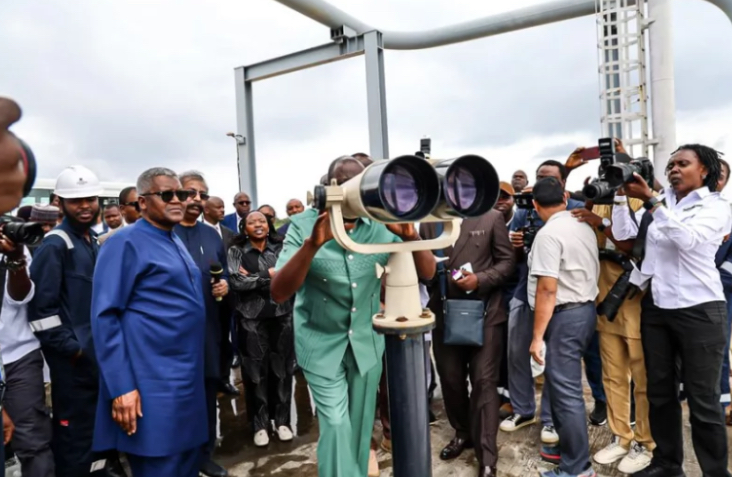
During Friday’s visit, Dangote and senior company officials led Ruto on a guided tour of the refinery and adjoining petrochemicals complex.
The tour covered key sections of the facility, including its refining operations, processing infrastructure and petrochemicals facilities.
Also Read: Petrol receipts rise as Dangote runs above capacity
Officials also briefed Ruto on the various stages of the refining process and the facility’s role in meeting energy and petrochemical demand in the region.
The Dangote Petroleum Refinery has a capacity of about 700,000 barrels per day and is one of Africa’s largest refining facilities.
The project was initially earmarked for Tanzania before Dangote Group shifted it to Kenya, citing infrastructure, logistics and market considerations.
From Lagos, Ruto is expected to return to Kenya and begin a week-long working tour of the Coast region on Saturday.
The tour will cover Taita-Taveta, Kwale, Kilifi, Mombasa, Tana River and Lamu counties, with activities focused on development projects, land reforms and investments.
A major part of the tour will be the issuance of nearly 200,000 title deeds to residents across the six counties.
Ruto will begin the tour in Taita-Taveta, where 31,318 title deeds are scheduled for distribution to residents of Mwatate and Voi constituencies.
He will proceed to Kwale on Monday, where 94,175 title deeds are expected to be issued in Lunga Lunga, Msambweni and Kinango constituencies.
In Kilifi, 36,826 title deeds are lined up for beneficiaries in Kaloleni, Rabai, Ganze, Kilifi South and Malindi constituencies.
Mombasa is set to receive 4,360 title deeds, while another 22,770 documents will be distributed in Lamu and Tana River.
The government says the documents will give beneficiaries formal ownership of their land and allow them to use the property for economic activities.
Ruto is also expected to commission completed projects, inspect ongoing works and launch new developments during the tour.
The Lamu refinery groundbreaking is expected to be a major event during the visit, placing the Coast region at the centre of the government’s energy and industrialisation plans.
The project is also expected to support employment and regional trade through petroleum supply chains serving markets beyond Kenya.
The Star