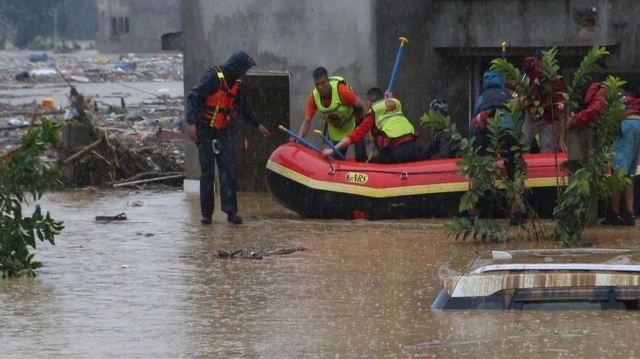
At least ninepeople have been killed and hundreds remain missing after a powerful flash flood swept through remote Himalayan valleys along the Nepal-Tibet border on Wednesday, destroying homes, roads, bridges and electricity infrastructure.
The flooding struck Nepal’s mountainous Rasuwa district, particularly the areas around Timure and Syabrubesi, after a sudden surge in the Bhote Koshi River.
The disaster also affected the neighbouring Chinese side of the border, where a mudslide hit the Gyirong area and disrupted roads, power and communications.
The Nepal Tourism Board said 384 travellers had been reported missing, including 291 foreign nationals and 93 Nepali citizens.
Indian nationals account for 105 of those listed as missing, while other foreign nationals include people from Australia, the Netherlands, the United States, Malaysia, the United Kingdom and South Africa. The list remains preliminary and authorities are working to verify the whereabouts of those affected.
The missing travellers had been visiting or travelling through the region on routes connected to the popular Langtang trekking area, as well as journeys towards Mount Kailash and Lake Mansarovar in Tibet.
The Tourism Board said it was working with travel agencies, guides, local authorities, tourism police and security agencies to establish who remains unaccounted for.
The disaster also left security and government personnel missing. A Nepali police spokesperson said at least 26 police officers were still unaccounted for, while officials were also gathering information about missing revenue officials and workers at hydropower facilities.
“There is devastation everywhere we look,” Tula Bahadur BK, a health worker in Rasuwa district, told Reuters. “The settlements next to the river have been completely swept away. Five of my own relatives are missing.”
Nepalese authorities have linked the disaster to an event in the high Himalayas, with officials saying an earthquake may have triggered an avalanche or ice-and-rock collapse that subsequently caused the sudden release of water into the river system.
A separate assessment cited by Nepalese officials has also raised the possibility of a glacial or upstream blockage contributing to the sudden flooding. The precise cause remains subject to investigation as rescue teams assess the heavily damaged area.
Also Read: FG issues flood alert nationwide
The floodwaters moved with enough force to sweep away entire settlements and severely damage the infrastructure linking Nepal with China. Police stations, customs facilities, private homes, roads and bridges were among the structures affected.
The Rasuwagadhi border crossing, an important trade and travel route between Nepal and China, was also affected, while damage to hydropower infrastructure disrupted part of Nepal’s electricity-generating capacity.
Nepal deployed military and police personnel, along with more than a dozen rescue helicopters, to the affected areas. However, the high water levels and difficult mountainous terrain prevented helicopters from landing safely in some of the worst-hit locations.
Prime Minister Balendra Shah ordered security forces to assist with rescue operations and urged people living downstream and along riverbanks to move to safer locations. “People along the river are advised to exercise extra caution and remain alert,” Shah said.
Authorities have also warned residents downstream of the Bhote Koshi and Trishuli river systems to remain vigilant as rescue and assessment operations continue.
On the Chinese side, the mudslide struck near Gyirong Port in China’s Tibet region, cutting off roads leading to the border crossing and disrupting electricity and communications.
Chinese state media reported that authorities had mobilized hundreds of rescuers, while President Xi Jinping ordered an intensive rescue operation and called for authorities to make every effort to locate missing people, treat the injured and minimize casualties.
Chinese authorities also warned of the possibility of further casualties as they assessed the extent of damage in the affected border areas.
The immediate danger may not yet be over. Qianggong Zhang, head of climate and environmental risks at the International Centre for Integrated Mountain Development, warned that a blockage remains upstream along the Nepal-China border river and could trigger another surge of water if it fails.
The warning has prompted authorities to urge communities downstream to remain alert and prepare to evacuate if water levels rise.
The scale of the disaster remains difficult to establish because roads and communications have been damaged and some affected areas remain inaccessible.
Search teams are continuing to work through the debris and damaged settlements as authorities update the number of dead, injured and missing.
For families waiting for news of relatives and travellers, the immediate priority remains locating those who have lost contact and moving people in vulnerable river valleys to safety as the threat of further flooding persists.
REUTERS