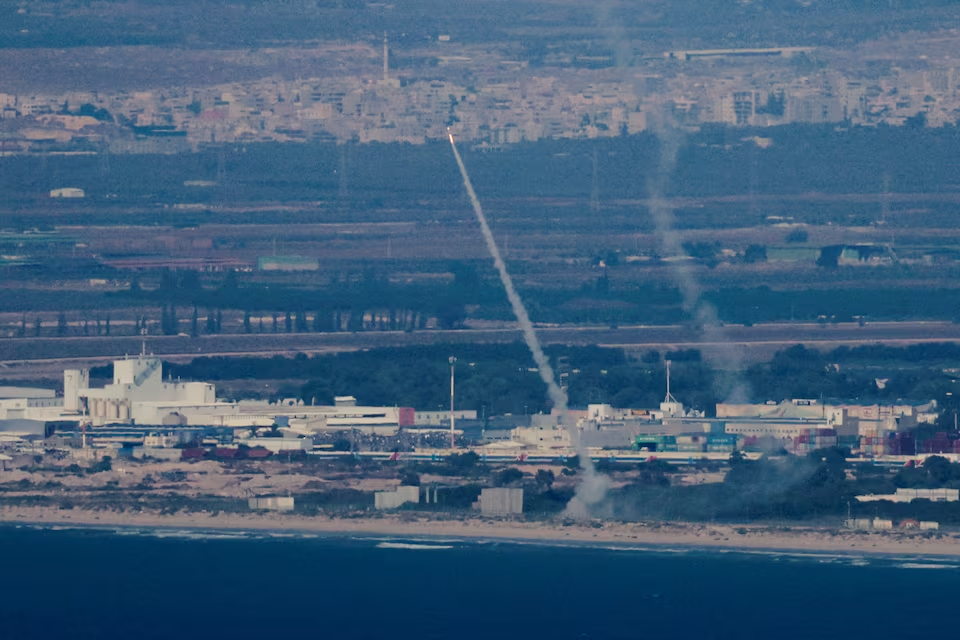
Hezbollah claimed responsibility for firing a missile aimed at the Mossad intelligence headquarters near Tel Aviv on Wednesday, while Israel retaliated with its most intense airstrikes in a year against southern Lebanon.
The Israeli military disclosed that the missile launched from Lebanon was intercepted by its air defense systems before it could cause any damage. Sirens blared in Tel Aviv and other areas like Netanya, but no casualties or destruction were reported.
Israeli military spokesperson, Nadav Shoshani, stated that while Hezbollah claimed the target was Mossad’s headquarters, it was unclear if that was their actual objective. He clarified that the missile was directed toward civilian areas in Tel Aviv, which are not near the Mossad facility.
The current round of hostilities escalated following the conflict that broke out last October between Israel and Hamas in Gaza. Hezbollah, aligned with Hamas, has engaged in daily rocket fire exchanges with Israel along its northern border, resulting in heavy fighting in southern Lebanon.
Israel’s focus has now shifted to its northern frontier, with airstrikes targeting Hezbollah leaders and infrastructure in southern Lebanon and the Bekaa Valley. Hezbollah has responded by launching hundreds of missiles and rockets into Israel, intensifying the ongoing conflict.
Hezbollah has accused the Israeli intelligence agency Mossad of orchestrating the recent assassination of its leaders and a devastating attack that involved booby-trapping communications devices, resulting in the deaths of 39 individuals and injuries to nearly 3,000 people—the most significant security breach in the group’s history.
In the ongoing Israeli offensive, Health Minister Firass Abiad reported to Al Jazeera TV that 569 people, including 50 children, have died, while 1,835 have been injured since Monday morning. Foreign Minister Abdallah Bou Habib indicated that approximately half a million people have been displaced in Lebanon, with many taking refuge in schools and public buildings in Beirut after fleeing southern Lebanon.
READ ALSO : Hezbollah promise retaliation on Israel after deaths from pager explosions
On the same day, the Israeli military announced that it had intercepted a drone that had crossed into Israeli airspace from Syria, near the Sea of Galilee. Additionally, armed groups in Iraq claimed to have targeted a site in the occupied Golan Heights using a drone.
Israeli military officials are preparing for a range of military responses, recognizing Hezbollah as a more sophisticated and experienced adversary compared to Hamas. Iran’s Supreme Leader, Ayatollah Ali Khamenei, stated that the assassination of key Hezbollah figures would not lead to the group’s defeat.
Israeli forces have been conducting extensive training for a potential ground operation in Lebanon aimed at securing its northern border and allowing displaced residents to return home, a top priority for Prime Minister Benjamin Netanyahu’s administration. Despite international concerns over rising civilian casualties, the United States has continued to support Israel, while Arab nations have condemned Israel’s actions but have not taken substantial steps to mitigate its military power.
A recent strike in Beirut resulted in the death of senior Hezbollah commander Ibrahim Qubaisi, who was responsible for the group’s missile and rocket operations. The escalation of hostilities has raised alarms that the conflict could spread beyond Gaza.
U.N. Secretary-General Antonio Guterres warned that “Lebanon is at the brink,” emphasizing the need to prevent it from becoming another conflict zone like Gaza. Israeli Defense Minister Yoav Gallant stated that the offensive has significantly weakened Hezbollah, affecting its command structure and combat capabilities.
Credible News.ng