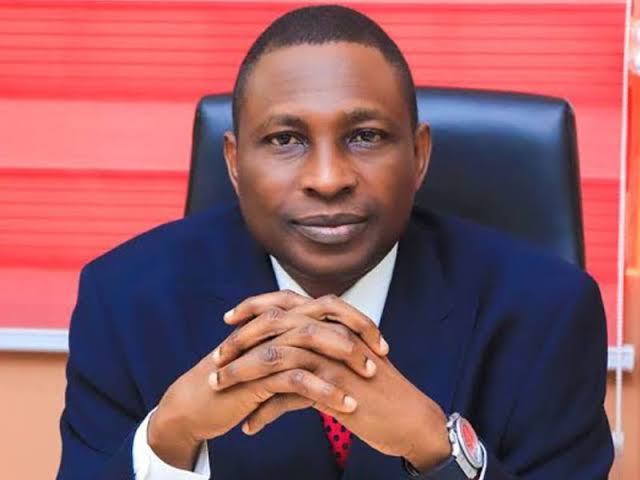
The Executive Chairman of the Economic and Financial Crimes Commission, EFCC, Ola Olukoyede has issued a stern warning to Nigerians against abusing the national currency, emphasizing that practices like spraying and stamping on the naira are criminal offences, not cultural expressions.
Speaking at a stakeholders’ sensitisation programme in Lagos on Friday, Olukoyede described the naira as a “symbol of our sovereignty” and expressed concern over its frequent abuse during social events. He noted that the EFCC has intensified its clampdown on such violations, alongside its ongoing war against unlicensed foreign exchange operations.
“Throwing money in the air is not a show of wealth — it’s a violation of the law. Nobody who works hard for money will spray it carelessly,” he said.
To address these issues, the EFCC has launched a special task force in collaboration with the Central Bank of Nigeria, focusing on currency abuse and dollarisation of the economy.
“There is absolutely nothing cultural about destroying our national currency,” the EFCC chairman stated, debunking the widely held belief that spraying money is a harmless tradition.
Olukoyede also pushed back against public suggestions that the EFCC should focus only on “big fish,” stressing that no crime is too small to prosecute. “An offence is an offence. Celebrities facing prosecution know that no one is above the law,” he said.
Under his leadership, Olukoyede said the EFCC has embraced a more strategic and balanced approach—one that supports legitimate businesses while targeting fraud. He noted that companies under investigation are no longer abruptly shut down, with reforms introduced to safeguard jobs and investments.
READ ALSO: Court bars EFCC from seizing visitors’ phones
He revealed that over ₦100 billion in recovered assets have been redirected into key social intervention programmes under the Tinubu administration, such as the Nigerian Education Loan Fund and the CrediCorp consumer credit scheme.
“These are not just headlines. These are real results — social programmes funded with money recovered from corrupt individuals,” he said. Notable recoveries include funds from the Niger Delta Development Commission (NDDC), used to build a skills acquisition centre and liaison office in Bayelsa State, and property in Kaduna, now repurposed as a federal university.
Internationally, the EFCC is working with global partners to repatriate stolen assets and has already refunded victims of fraud in countries like the U.S., Canada, and Spain.
Olukoyede further disclosed that recent sting operations in Lagos and Abuja led to the arrest of 792 suspects, with more than 150 Chinese nationals already facing trial for various offences. He confirmed that trials for four former governors and three ex-ministers are also underway.
As part of its preventative efforts, the EFCC has established a Department of Fraud Risk Assessment and expanded public outreach through EFCC Radio 97.3FM, regular TV/radio shows, and X Spaces (formerly Twitter).
“The naira must be treated with dignity,” Olukoyede concluded. “This is a national fight. It’s not for the EFCC alone — it’s a shared responsibility for every Nigerian.”
Punch Newspaper