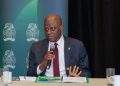
President Bola Tinubu has called on world leaders to unite, show courage, and remain committed to confronting the worsening climate crisis.
He made the appeal during a high-level virtual dialogue on climate and just transition held on Wednesday and co-hosted by the UN Secretary-General, António Guterres, and Brazil’s President Luiz Inácio Lula da Silva.
The meeting, which drew participation from 17 countries—including China, the European Union, the African Union, ASEAN, and small island nations—was aimed at building momentum toward COP30, scheduled to hold in Brazil.
Speaking from Abuja, President Tinubu reaffirmed Nigeria’s resolve to align climate action with economic growth, describing the global climate emergency as a “strategic imperative” rather than a development cost.
He highlighted Nigeria’s Energy Transition Plan, which charts a path to net-zero emissions by 2060 across five sectors: power, cooking, transport, oil and gas, and industry. The plan identifies a funding need exceeding $410 billion to achieve its targets.
“We are aligning our regulatory frameworks and fiscal policies to ensure energy access, decarbonisation, and economic competitiveness go hand in hand,” Tinubu said in a statement issued by his spokesman, Mr Bayo Onanuga.
The President also spotlighted Nigeria’s leadership in the Mission 300 initiative—a partnership with the World Bank and African Development Bank—to provide electricity to 300 million Africans by 2030.
READ ALSO: Steel Minister urges support for Tinubu’s agenda
Referencing Nigeria’s role in the Dar es Salaam Declaration and the presentation of its National Energy Compact, Tinubu emphasized measurable goals to expand clean energy access and modern cooking solutions, describing the compact as one of Africa’s first of its kind.
He announced that Nigeria finalised its Carbon Market Activation Policy in March 2025, a move projected to unlock $2.5 billion in high-integrity carbon credits by 2030.
Tinubu further disclosed that Nigeria was in the process of revising its Nationally Determined Contributions, with plans to submit the updated climate commitments by September 2025.
Beyond policy, he noted, Nigeria is developing a Global Climate Change Investment Fund to attract climate-smart investments.
The fund aims to de-risk green infrastructure and scale clean energy projects in key areas such as e-mobility, regenerative agriculture, and mini-grid renewables.
He appreciated the support of international partners, particularly the United Nations and Sustainable Energy for All, for their technical and advisory roles in advancing Nigeria’s climate agenda.
“These partnerships demonstrate the value of multilateral cooperation,” Tinubu said. “We are ready to lead, collaborate, and deliver—because the time for action is now.”
NAN